Two weeks ago, I handed my whole content pipeline to Claude Code. Then, I spent the next two weeks refining. Here’s what I learned.
I know, I know, it’s been a couple of weeks.
Would you believe my poor pup got sick (like… emergency-vet sick), and then I got sick. A solid chunk of the last two weeks, lost to the couch. The one upside? That couch time went straight into tinkering with the pipeline I showed you last issue.
So let’s jump into the verdict, because I know that’s what you came back for. It works!
It also absolutely, positively needs a human in the loop and unique inputs in order to produce something worth posting.
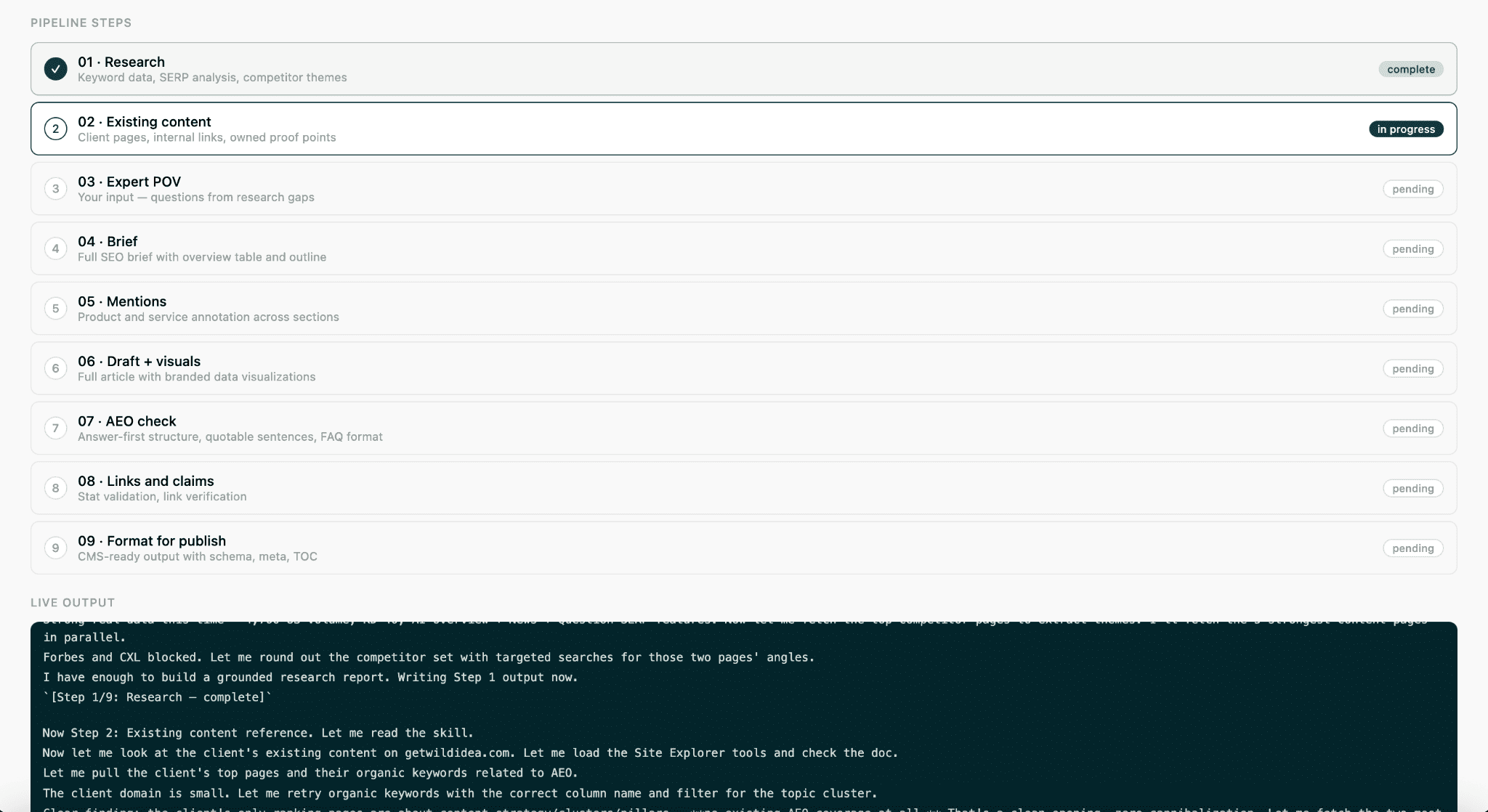
What I built
For anyone just tuning in: I rebuilt my entire content process in Claude Code, from keyword research all the way to a publish-ready draft.
Nine steps, each one its own skill file that tells Claude what to read, what to do, and how to do it my way.
The bulk of the workflow includes the stuff I never wanted to do by hand in the first place. It…
-
pulls live keyword and SERP data straight from Ahrefs (no dashboard, no exporting spreadsheets),
-
maps what the client site already ranks for so we don’t cannibalize ourselves,
-
drops in product mentions where they actually help the reader,
-
validates every claim,
-
and formats the whole thing for the CMS.
Those parts? It’s incredibly helpful to let the robots handle it. It saves me a buttload of time, and I do not miss doing a single bit of it.
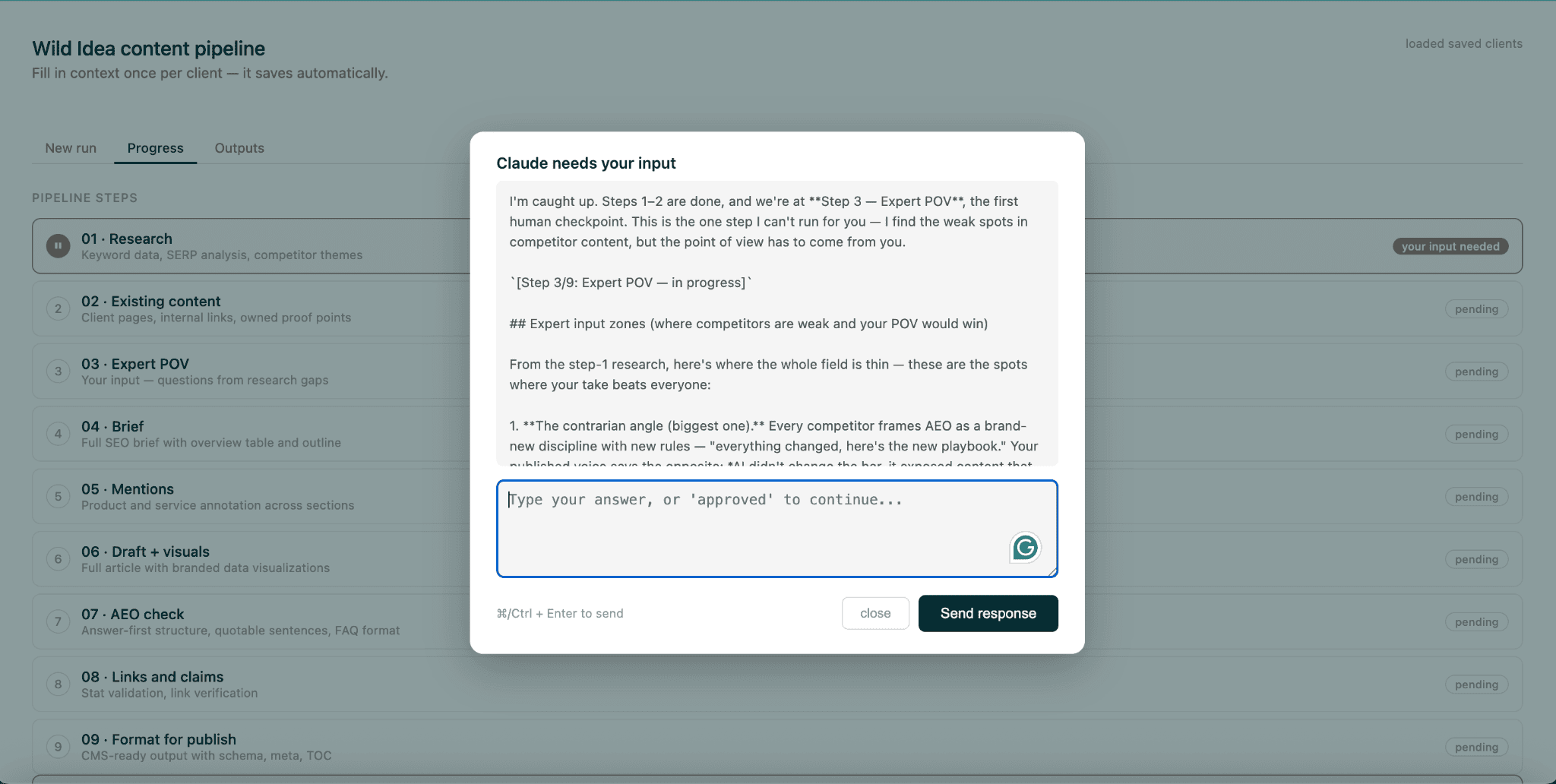
Where it stops and waits for me
Step 3 is where the real magic happens.
By that point, Claude has done its research and found opportunities for differentiation—the spots where every competitor is saying the exact same thing, and there’s room for a real point of view. So it writes up questions based on those gaps, and then it waits for the expert input. Nothing downstream is allowed to run until a unique point of view and expert opinions have been added into the mix.
Then it builds the brief around those answers while still considering the intent of the piece.
Note: the order here matters. The expert POV shouldn’t be a garnish you sprinkle on at the end. It shapes the brief, and the brief shapes everything after it. Feeding it a point of view later in the game means you’ve already written a generic article with a quote or two stapled on. Feed it in at step 3, and it’s baked in from the beginning.
From there, you can take that meaty-as-heck brief and pass it on to a writer, or let the workflow take a stab at drafting. I was actually surprised at the quality of the drafts, but more on that later.
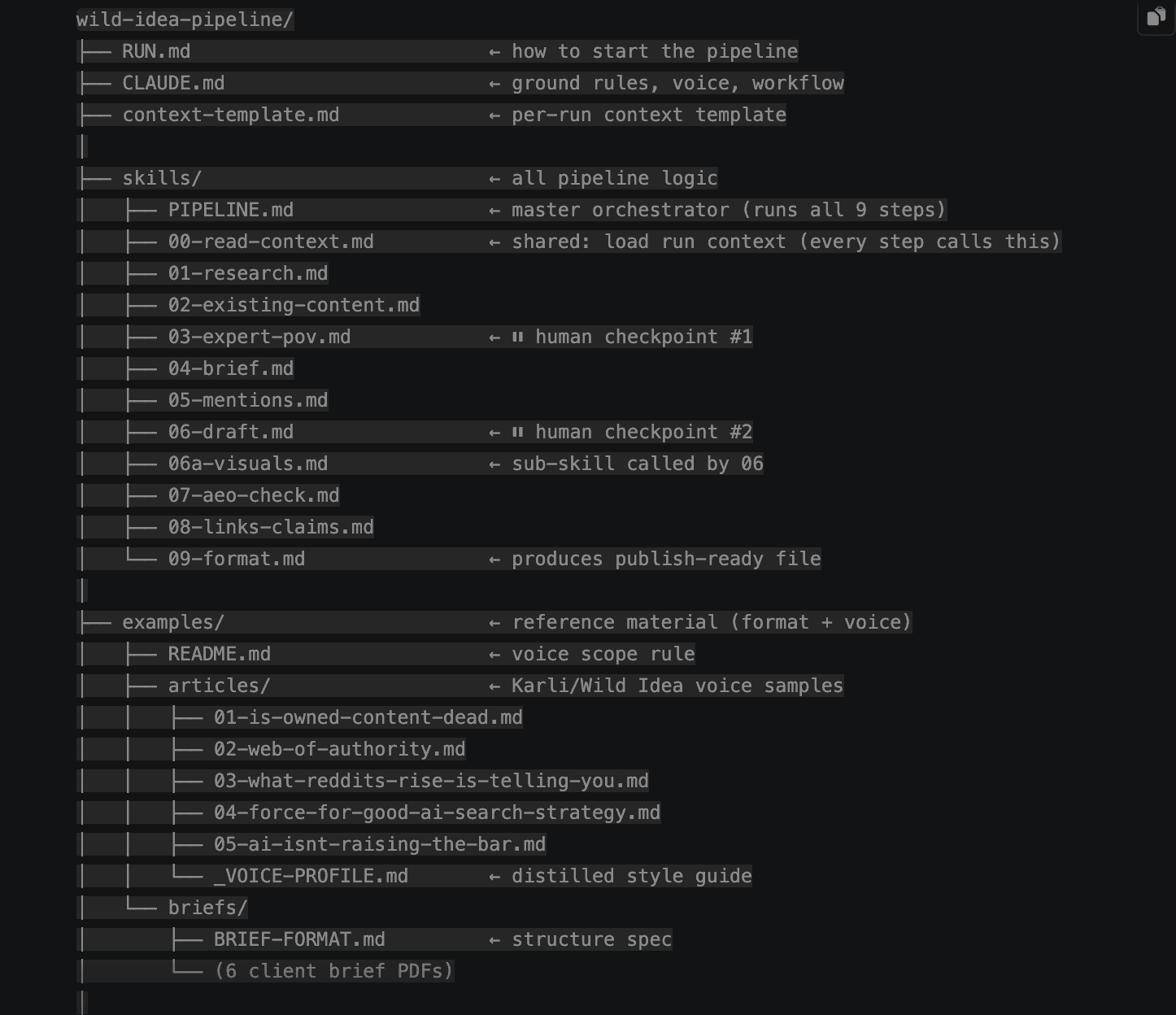
What two weeks of refining actually looked like
Here’s the part nobody mentions when they post their shiny new workflow: you do not get it right on the first pass. Or the fifth.
The way it actually goes is you build the thing, run it, and immediately spot something missing. You fix that, run it again, spot the next gap. I ran the full pipeline SO MANY times over two weeks, refining every output and ensuring every skill was up to spec.
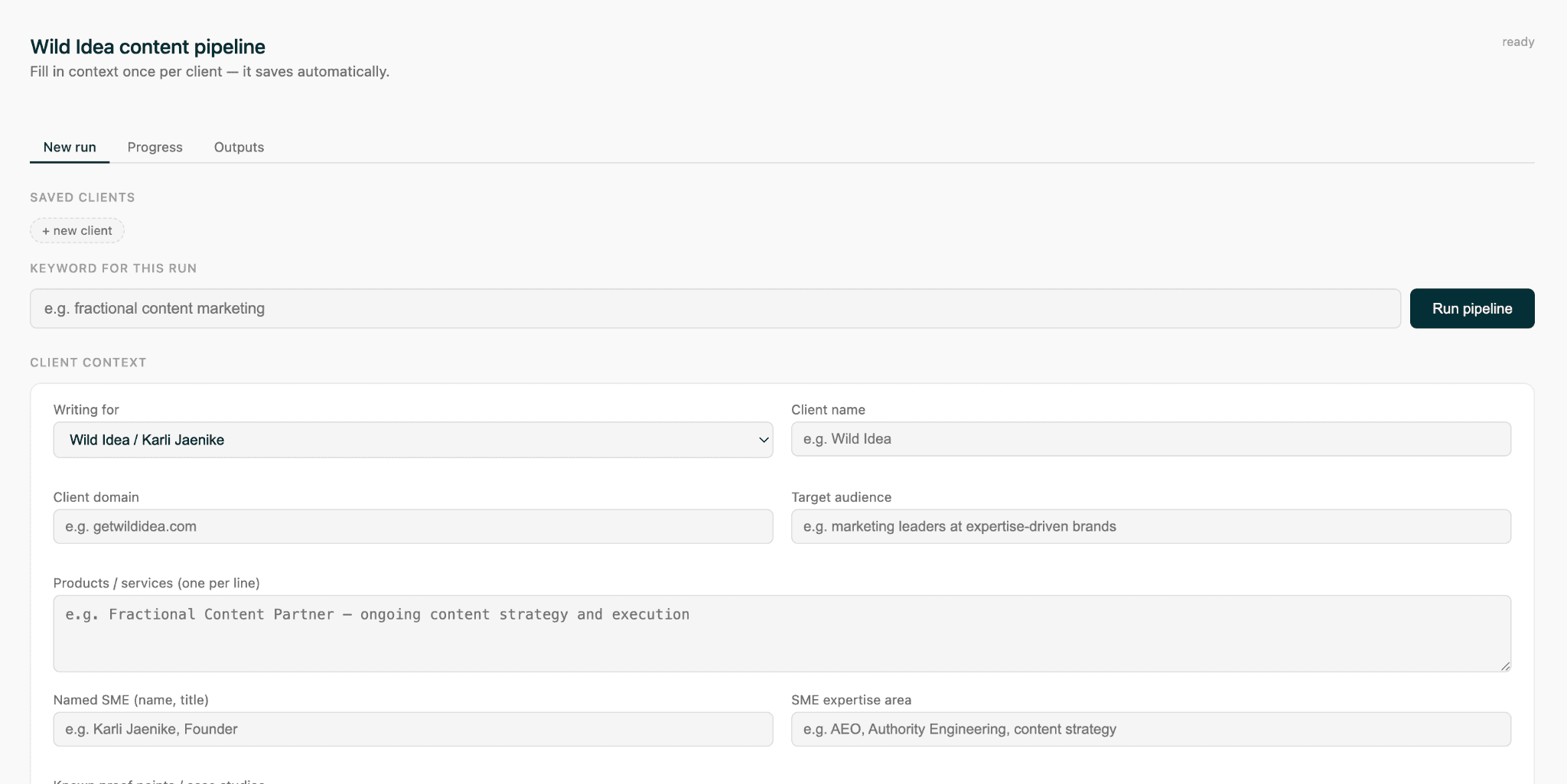
My favorite example, because it’s so perfectly on-brand for this newsletter: the first version of the expert-input step had nowhere to actually put the expert input. Claude would generate its questions and dump them into a read-only log. The one step whose entire job was to get a human involved had no way for the human to respond. I had to go back and build the input box myself. The human-in-the-loop step didn’t have a loop.
Most of the fixes were like that. Small stuff, obvious in hindsight, the kind you’d only ever catch by running it with real work in front of you.
What I learned
I think the big learning is something that I’m not necessarily surprised by, but I am surprised at how well it worked: the SME input. I’ve been so vocal against purely AI-generated content, because who wants an internet filled with content written by machines?
But of course, I had to try it myself and confirmed there is a way to strike a happy medium. Hand AI a keyword and not much else, and it writes the same article everyone else’s AI is writing. It pattern-matches to the consensus and gives you a competent, forgettable page that adds one more drop to the sea of sameness already out there.
And that sameness is a real problem now, because the models (and, of course, humans) have started skipping right over it. A study out of Princeton and Georgia Tech found that content with real statistics, expert quotations, and a unique POV saw a 40% increase in the visibility of AI answers.
There’s a mechanical reason underneath that. When the useful bit of your content is something only your expert knows, or data only you have, the model can’t grab it from anywhere else. It either cites you, or it doesn’t cite the point. Consensus filler, on the other hand, is available on ten thousand other pages, so there’s no reason to pick yours.
A pleasant surprise: once I forced a real point of view into the process up front, AI got shockingly good at carrying it out, weaving that angle into the brief and then the draft in a really smart way. That’s the part I was skeptical of.
Refining the voice and draft outputs
Testing it on my own writing was one thing. The real test was a client whose voice sounds nothing like mine.
I pointed it at their writer’s guide and published content, and it pulled their actual voice out of their posts, kept the things that made them sound like them, and dropped the AI tells along the way.
About that: I had to actively teach it to avoid AI tells. I created a skill that lists a whole lot of stuff that looks like “style” to an LLM, but is instantly distinguishable to a human. Overusing dashes. Wrapping every section up with a tidy little bow. The “everyone thinks X, but actually Y” opener.
I applied all those hard bans across all clients. I actually have an entire list of these AI tells; comment “AI Tells List” below, and I’ll share it! After some refinement, I was actually pretty happy with the draft output.
The layer I didn’t expect to love
The sleeper hit of this whole build is the claims-and-links checkpoint.
After the draft, but before the draft QA, there’s a step that verifies every stat and every source in the draft against the actual source, rather than trusting whatever the model thinks it “remembers.” You’d be surprised how often it’s working from memory.
Anything it can’t confirm gets flagged for a human check. I went through and checked its work by hand (even things that weren’t flagged), fully expecting to catch hallucinations or miscitations, but nothing questionable made it through.
This is a game-changer, especially for content creation in YMYL or highly regulated industries, where citing false information can be detrimental to a brand’s reputation.
So, is AI content “there” yet?
Yes and no.
For the last few years, using AI to draft meant spending more time stripping out the AI-isms than you’d have spent just writing the dang thing yourself.
Now, I think that’s finally starting to shift. While of course you should not post AI drafts without serious editorial oversight, it’s finally more of a time-saver than a time-suck.
Give it a real brief and a real point of view going in, and AI will now hand me a brief and/or a first draft that’s a legit starting point that I can build from.
Next? Now that I’m confident in the outputs, I’m going to use these bones to create an AI refresh workflow. I’ve created one in AirOps, but having my very own, highly tailored version is going to be money-in-the-bank.
If you want a system like this living inside your own business, whether that’s something custom or set up in a tool you already use, that’s exactly the kind of work I do. Come say hi.

Karli Jaenike is the Fractional Organic Content, SEO and AI Search Strategist behind Wild Idea, where she helps growth-stage companies turn deep internal expertise into content that search engines rank and AI systems cite. She has 10+ years across editorial strategy, SEO, and content systems, including leading SEO content at Eventbrite and working with enterprise clients at Siege Media. Her framework, Authority Engineering, surfaces the knowledge already inside a company, structures it for both traditional search and AI discoverability, and uses AI-assisted workflows to produce and distribute it at scale. She writes After the Algorithm, a weekly newsletter on AI search and SEO. Based in Texas, she’s a nature lover, live music fan, and travel enthusiast.