Organic traffic is down for many brands. AI Overviews are cutting into click-through rates to pages that rank in the top spots. That content library you spent years building? It’s suddenly becoming a lot harder to defend.
If you’re in SEO or content right now, you’ve probably felt it.
The shift to zero click is forcing organic marketers to think outside the SEO box. Now, on top of creating content worth ranking, we’re thinking about how to optimize content for AI, how our content can work harder through distribution, and how to measure attribution that our current analytics weren’t built to capture.
But it’s important to remember: a lot of what’s actually being disrupted is content that never should have worked in the first place.
High-volume, surface-level, algorithm-chasing content was always going to be replaceable.
The brands that have invested in building real authority, prioritized original thinking, and created content that could only come from genuine expertise are better positioned than they realize. Their analytics just haven’t caught up yet.
AI optimization goes far beyond on-page formatting (though that still matters). You have to leverage the expertise you have to convince the LLMs you’re worth citing. On your own site, yes, but also across owned channels, in third-party coverage, across anywhere your audience might be lurking.
In this guide, we’ll chat about AI search as a multi-channel effort, so that you can start gaining visibility where it matters most.
⬆️ Subscribe to our brand-spankin’ new YouTube channel!
Summary:
- Rankings and AI visibility are two different things — 88% of AI citations don’t come from the organic top 10, which means your current SEO strategy isn’t enough on its own.
- Your website is only one piece of the puzzle. AI builds a picture of your brand from everywhere you show up, including LinkedIn, YouTube, third-party coverage, and beyond.
- Your biggest competitive advantage is already inside your organization. Brands that extract and distribute real internal expertise are winning faster, and with more staying power, than those chasing content volume.
From Traffic to Trust, AI Search Changes Everything
AI content optimization is becoming known as the practice of structuring your content to be selected and cited by AI-powered search systems—but it’s so much more than that.
Traditional SEO asks, “How do I rank #1 for this keyword?” AI optimization adds a second question: “How do I become the entity AI recommends when synthesizing an answer on this topic?”
That second question matters more than most brands realize. Google AI Mode has reached 75 million daily active users, a fourfold increase since its May 2025 launch, and 37% of consumers now start their searches with AI tools instead of Google entirely.
At first, many marketers assumed that ranking on Google meant being visible in AI, but that assumption is breaking down fast.
Ahrefs found that 88% of AI Mode citations don’t appear in the organic top 10. Your rankings and your AI visibility are two separate things, and treating them as the same thing is one of the more expensive mistakes you can make right now.
Google is only half the conversation.
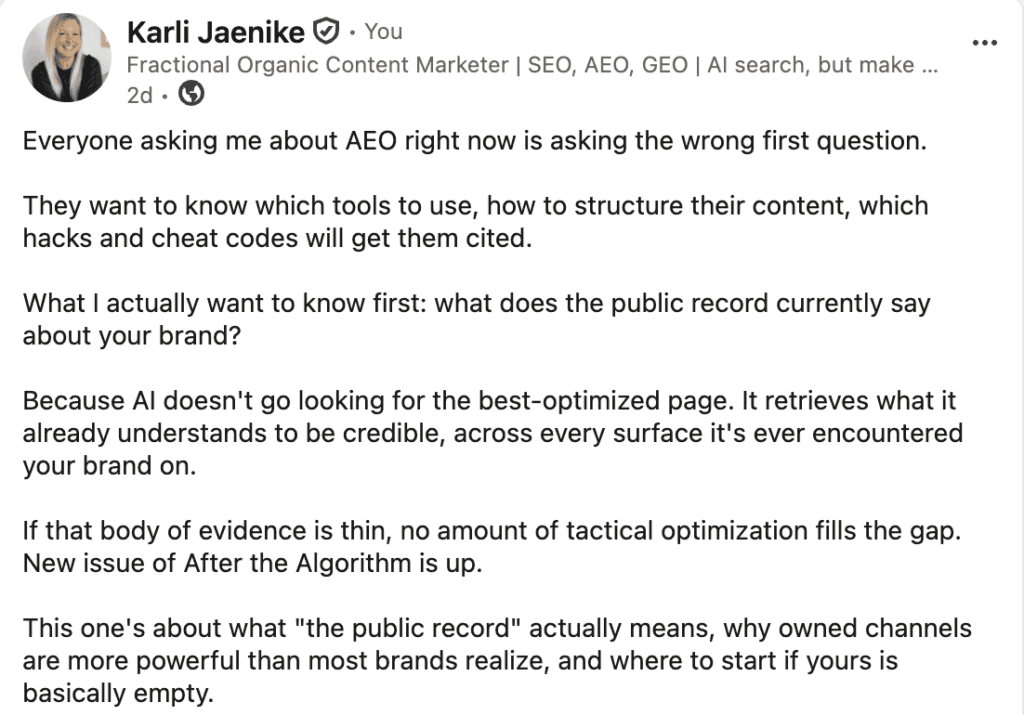
AI systems are building a picture of your brand from everywhere you show up: your owned content, yes, but also the quotes attributed to you in other publications, the LinkedIn articles tied to your name, the YouTube videos your team has scripted and published.
Your expertise needs to show up across every owned surface, reinforcing the same message. The one you actually want to be known for.
That’s authority engineering: the deliberate practice of building your web of authority across the sources AI systems already trust.
It requires consistency; the long game of making sure that when an AI synthesizes an answer in your category, your brand has left enough of a footprint to get pulled into the conversation.
Content Volume No Longer Works. Value Does.
While we’re on the topic of consistency, it’s worth noting that we’re past the point where publishing more equals more visibility. Particularly when publishing more means lower quality content, or content that’s not directly tied to your product or offering.
Content today needs to be opinionated, informed, and genuinely useful—not “helpful” in the generic SEO sense. It needs to offer a truly unique perspective.
The question worth asking before every piece: what do we know about this topic firsthand? Where do we have lived experience?
That’s your moat.
When you tap into real expertise that already exists inside your organization, you tap into that lived experience so that you can share it with the world.
You’re, of course, looking for expertise that’s directly tied to your offerings so that you can…
Share a point of view; a distinct perspective on a topic is increasingly what separates content that gets cited from content that gets ignored
Answer the exact questions your audience is actually struggling with
Include real-world advice, manufacture original data, and give specific examples and use cases
The Real Visibility Gap
Most brands’ LLM strategy has the same gap, and it comes down to this: they aren’t showcasing their expertise outside of their website, blog, or learning hub.
On-site, authoritative content is becoming table stakes.
Alongside it, you should be publishing directly to the surfaces AI engines already treat as authoritative: YouTube, LinkedIn, the third-party outlets that cover your space.
The biggest hack? Marrying the internal expertise you have with multi-channel distribution. Many times, your internal experts will have credibility built elsewhere.
Maybe they’ve co-authored a study on the topic, or maybe they’ve previously shared their unique point of view in news articles or on podcasts.
This built-in authority translates to the content created by your brand, helping your content rank faster, and giving your distributed content an authoritative edge. Simultaneously, this all signals to AI that you are the go-to source for an given topic, which leads to citations, recommendations, etc.
For example, I just wrapped up a fractional engagement where we worked with their Chief Science Officer to create our content pieces. She already has studies published, and is super active in the scientific community beyond the client’s company.
The results? Almost immediate rankings, AI citations galore, and a 154% increase in organic traffic in 90 days.
This engagement solidified what I knew in my head was true. Expert knowledge, properly structured, and distributed? This is the way.
You can read more about our results here.
How to Optimize for AI Search
Authority engineering is, of course, one piece of the puzzle. Structure and the principles behind why it works still matters, and, you may notice that many of these are rooted in SEO best practices.
Which is nice, because it means these strategies layer nicely on top of one another—you shouldn’t ignore SEO in favor of AI search optimization, they need to live together, like a happy little family.
Structural and Technical Optimizations
A few things to keep in mind when structuring written content for AI citation:
- Q&A format is the best-performing structure, but that doesn’t read super natural for humans. Structured content with clear headings and easy-to-scan lists gets the job done in most cases. Avoid dense paragraphs, as they’ve been shown to perform the worst.
- Page speed is a citation factor, not just a UX consideration.
- 44.2% of all LLM citations come from the first 30% of your content, so make sure the value is front-loaded, not buried.
Side note: Content freshness matters big time. Seer Interactive analyzed 5,000+ URLs across ChatGPT, Perplexity, and AI Overviews and found 79% of AI citations came from content published in the last two years, with 65% from the last year alone. Publishing a strong article and leaving it untouched is no longer a viable strategy.
Here’s a checklist you can use to quickly ensure your content is meeting the above specifications + more:
- Explicit headings that clearly signal topic boundaries. Don’t make AI guess what a section is about.
- Short paragraphs with one idea each. Dense blocks increase processing cost without adding meaning. (Note: keep this within reason; you don’t want to sacrifice readability for LLM processing.)
- Direct definitions stated plainly, not implied. If you’re introducing a term, define it.
- Q&A formatting for any content answering a specific question, and at the FAQ section at the end.
- Logical sequencing with supporting details placed where they’re needed, not buried three paragraphs deep.
- Bolded takeaways and pull quotes that can be extracted without full context.
- Schema markup — article and FAQ schema at a minimum.
- Fast load times. Slow pages are at a disadvantage.
- Regular content refreshes. Freshness is a ranking signal and a citation signal.
None of this is advanced, and a lot of it reads suspiciously similar to SEO best practices.
You’ll notice that the same thing rings true when it comes to signaling to the LLMs that you’re an expert worth citing.
Authorship Signaling + E-E-A-T
This is how you show LLMs that the content on your site is, indeed, written by someone who knows their stuff and is, in fact, worth citing.
You may remember that Google evaluates content using E-E-A-T: Experience, Expertise, Authoritativeness, and Trustworthiness. AI likely considers this in a similar way.
Strong authorship signals directly support all four. In an environment where AI-generated content is proliferating, the distinction between a named expert with a track record and an anonymous content factory is increasingly visible to both users and AI systems.
On-site authorship elements:
- Clear, prominent bylines on every piece of content
- Detailed author bio pages that link to credentials and previous work
- Topical consistency: authors who consistently cover specific subjects build stronger authority signals than generalists (this ties directly back into authority engineering)
Off-site authorship signals:
- Podcast appearances and media mentions that link back to author pages
- Strong social profiles tied to a clear area of expertise
- Contribution to studies, research projects, or think pieces
- Community engagement on third-party platforms: AMAs, presence in forums and discussion communities, panel participation
All of these work together to turn internal subject matter expertise into structured, citable content. It’s no longer just about optimizing in one place; you need to be thinking about the entire picture your brand is building.
Become THE Source
Structural optimization gets you in the game. Authorship signals establish your credibility. But neither guarantees that AI systems will reach for your brand when synthesizing an answer in your category.
That requires something more sustained: a consistent, compounding presence across the sources AI already trusts.
LinkedIn is now the #1 cited domain for professional queries across every major AI platform. YouTube’s share of social citations in AI doubled from 18.9% to 39.2% in just four months, per Goodie AI’s analysis of 6.1 million citations reported by Adweek.
These are owned channels. You control them. And they’re already feeding the AI systems your audience is using to make decisions.
As an added bonus, they can act as a foundation that diversifies your influence regardless of what Google, ChatGPT, or whatever comes next decides to prioritize.
YouTube
YouTube is the second-largest search engine in the world, and unlike most platforms, it has a compounding content model; videos published two years ago still drive views, subscribers, and trust.
According to BrightEdge’s AI citation analysis, YouTube averages a 20% citation share across AI platforms and holds the top spot in Google AI Overviews. Aside from that, you can link your YouTube content to your onsite content, reinforcing each other and building your web of authority.
The human advantage here? It’s that video is where audiences form opinions about whether they trust you. The expertise that lives in your content already has a second life here; the camera is just another distribution format.
Social and Multi-Channel Authority
Consistent presence across LinkedIn, Instagram, and TikTok builds something that’s hard to manufacture quickly: familiarity.
So, aside from LinkedIn being cited frequently by LLMS, Insta now being rankable in search, and TikTok being another place for your users to find you, they all act as yet another surface where you’re sharing your thoughts about *the thing*. Where people can interact with it, share it, and reinforce you as the go-to expert.
All of this fits together with authority engineering in that your internal experts are the PERFECT people to tap for this sort of content. And for your brand, maybe the expert *is* you, but when it’s not, you need to create systems that make it easy for you to extract these people’s knowledge and get it out onto these channels.
This could be a whole article in and of itself, so more on this coming soon.s.

How Do You Measure Content Effectiveness in a Zero-Click World?
When AI summarizes your content and answers the question directly, the click never happens. The reader still learned from you. Your analytics just don’t know it.
This is the measurement problem that’s becoming the bane of every marketer’s existence. Organic sessions dip, leadership sees a number go down, and content gets blamed—even when it’s doing exactly what it’s supposed to do.
The way you measure content has to evolve alongside how it’s consumed.
Track assisted conversions, not just last-click. Most content doesn’t convert on the first visit. Set up multi-touch attribution in GA4 to see which pieces appear in the path to a form fill, demo request, or purchase. The article that got zero direct conversions might be showing up in every buyer’s journey.
Watch branded search volume. When AI Overviews absorb clicks, impressions and traffic drop, but if your content is doing its job, branded search should rise. That’s the signal that content is building awareness even when it’s not generating clicks.
Just ask. A simple “how did you hear about us?” field on intake forms catches what analytics can’t. Dark social, word of mouth, and AI-assisted discovery are nearly impossible to track otherwise. It’s the oldest attribution method there is, and in a zero-click world, it’s having a comeback.
Other signals worth tracking:
- AI Overview citation: Are you being referenced as a trusted source?
- Conversion rate from content-referred traffic: Are readers taking action?
- Revenue attribution by content type: Which pieces and channels are actually driving pipeline?
- Email signups and lead conversions from content: Are you building an owned audience?
- Cross-channel resonance: Did a blog post drive replies on LinkedIn or shares in a newsletter?
- Prompt-level tracking: Some tools are starting to offer this, and while folks are largely agreeing these are less-than-reliable, it’s still worth checking if you’re showing up as the answer, consistently, in prompts that are very important for you.
None of these replaces traffic as a metric. But in an environment where AI is increasingly the last mile between your content and your audience, these signals can tell a story.
This New Era Rewards Real Marketing
The brands that invested in genuine expertise, built real authority, and created content that could only come from people who actually know their space are the ones positioned to win this next phase.
The shortcuts are gone. Marketers need to utilize every tool they have to build a real picture of authority for brands.
That means strategy, structure, and authority engineering. If you’re ready to rework your content strategy for this moment, whether that means rethinking your pillar pages, building a smarter repurposing engine, or structuring for AI, we’d love to help.
Not sure where to begin with AI optimization?
FAQs
What is AI optimization for publishHow is AI content optimization different from traditional SEO?
Think of it as SEO’s evolution, not its replacement. Everything that made traditional SEO work, topic research, content strategy, technical optimization, link building, still matters, just in different ways. The key difference: Google’s algorithm ranks pages; AI systems answer questions (and may recommend your brand, or cite it as a source). That shifts the emphasis toward cross-channel authority, explicit structure, and genuine expertise signals.
Which content types should I prioritize right now?
Case studies, think-pieces, and mid-bottom-funnel content that ties closely to product offerings are gaining ground. Top-funnel “what is” and unrelated how-to content have seen the largest declines. Original reporting, expert opinion, and content that requires human sourcing and verification are the most durable.
How do I win in AI Overviews?
Use clear structure, headings, lists, short definitions, and schema markup. AI systems favor content that’s skimmable and directly answers a user’s query.
Should I optimize differently for ChatGPT vs. Google AI Overviews vs. Perplexity?
The core principles are consistent: content depth, explicit structure, recency, and authority signals matter everywhere. The nuances: Google AI Overviews show a strong recency bias, Perplexity is even more recency-focused, and ChatGPT tends to reference a wider range of sources including lower-ranking pages. Build for quality and structure first, then layer in platform-specific signals.

Karli Jaenike is the Fractional Organic Content, SEO and AI Search Strategist behind Wild Idea, where she helps growth-stage companies turn deep internal expertise into content that search engines rank and AI systems cite. She has 10+ years across editorial strategy, SEO, and content systems, including leading SEO content at Eventbrite and working with enterprise clients at Siege Media. Her framework, Authority Engineering, surfaces the knowledge already inside a company, structures it for both traditional search and AI discoverability, and uses AI-assisted workflows to produce and distribute it at scale. She writes After the Algorithm, a weekly newsletter on AI search and SEO. Based in Texas, she’s a nature lover, live music fan, and travel enthusiast.