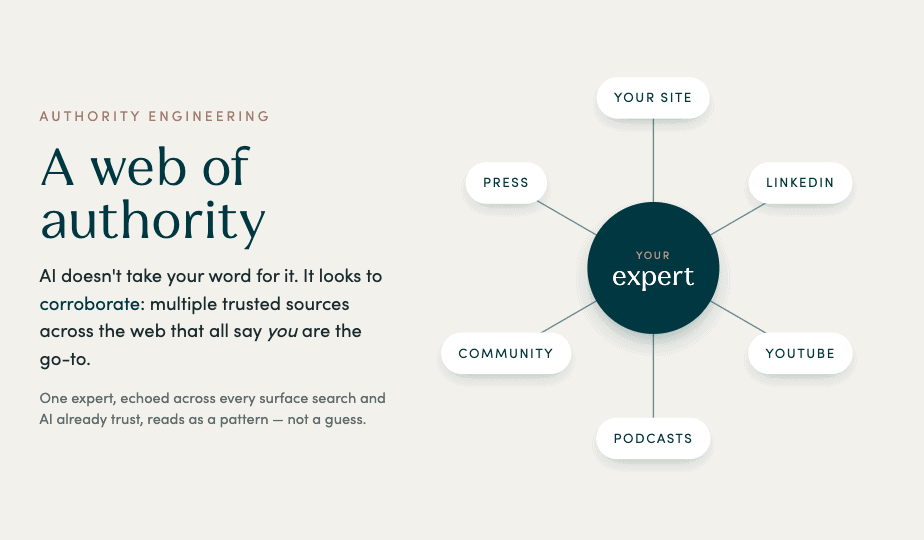
AI is looking to corroborate with a web of authority — multiple sources across the web that say YOU are the go-to. Here are the four elements behind the brands that keep getting cited, and how you can engineer authority too.
This is something that, as a marketer, makes a lot of sense; yet, I’ve seen so many brands underutilize it. That is: partnering with internal experts to build multi-channel authority that wins the brand AI citations and coverage in traditional search.
First, a little background. We did this during our work with Restore Hyper Wellness, and saw some of the quickest results I’ve seen in a while.
We identified an internal expert: someone who was already active in the scientific community, active on her own social, speaking at conferences and contributing to podcasts and studies. Then, we built the brand’s priority content around her actual clinical point of view (complete with quotes), turned that information into videos for YouTube (designed to also be shared across other social channels), and let it fly.
Ninety days later, organic blog traffic was up 154%, average search position had moved from 14 to 7, and AI citations had climbed from around 124 to nearly 650 in a single quarter. And we weren’t even publishing a TON of content: 8 pieces a month.
I wanted to ensure this wasn’t a one-off, so I did some digging. Over and over again, I saw successful brands using this strategy in one form or another, but I haven’t seen a ton of people break it down into a simple, repeatable process. I’m calling it Authority Engineering.
Authority Engineering for AI search (and SEO!)
Here’s what to do, step by step. It starts by taking the expertise sitting inside your company, structuring it so search and AI can read it, and publishing it across every surface AI and traditional search systems already trust.
The ultimate goal is a body of evidence, built on the channels you can control, and designed to be corroborated across channels you may have less control over.
But first, here’s what’s happening under the hood. AI and Google both weigh a claim by how verifiable the source behind it is. One mention of your expert is a data point. That same expert making the same point on your site, on LinkedIn, in a YouTube video, and in a podcast transcript reads as a pattern.
Publish that claim once, on a page with no named author behind it, and there’s nothing for these systems to verify, so it barely registers. Verifiable beats anonymous, and you can now watch that play out on the page: Google’s May update added an “Expert Advice” block that pulls firsthand takes from discussions and shows the creator’s name, handle, or community right next to the quote.
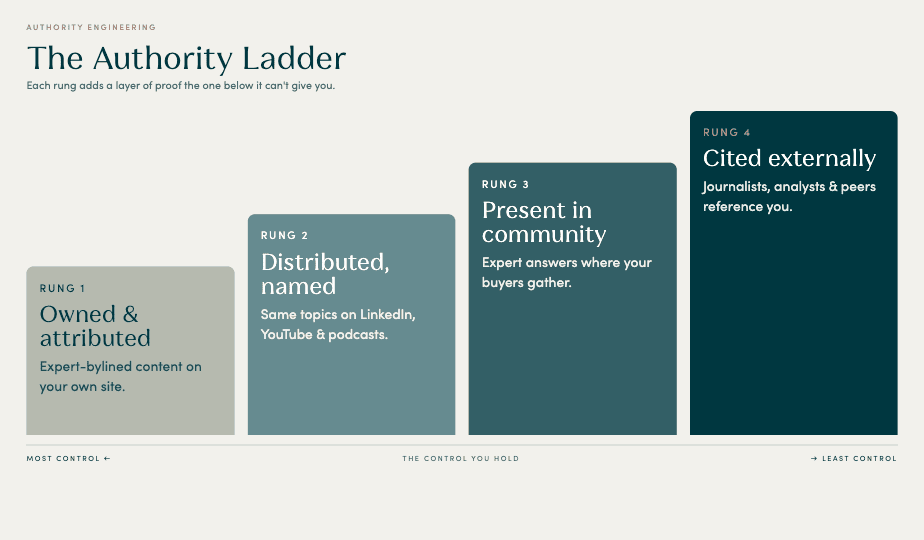
So how do you build toward this web of authority? Picture a ladder. Four rungs, each one adding a layer of proof the rung below it can’t give you.
Important: First, choose your expert(s), then, make sure they show up across each rung. In a perfect world, this expert will already have built a name for themselves: being active on social media, appearing on podcasts, contributing to news outlets, or having authored content elsewhere. If you can’t find that, it can absolutely be built from scratch, but that, of course, takes longer.
Rung 1: Owned and attributed content.
This is the content that lives ON your site. Ensure the chosen expertise shapes the content you’re creating — you want to make sure you’re showing up with a real, differentiated point of view, new stats/figures, expert quotes and more.
Ideally, this would be bylined by your expert (or at least reviewed by them). This piggybacks on their already-built reputation and builds brand authority around the topics you choose. Your on-site content is now credible in the eyes of AI and establishes E-E-A-T signals that have moved Google rankings for years.
Obviously, this content is optimized for traditional and AI search. This is my bread and butter, and I could talk about it for days, but I’ll save that for another article.
Rung 2: Distributed with the name attached.
Distribute the same topics (the topics you want to own) across channels that AI leans heavily on. It should be crystal clear that this content features the named expert. On some channels, like LinkedIn, it’s best shared by the individual, but on others (like YouTube) it can be published under the brand’s name.
This is where entity signals are built: the consistent footprint that lets a model recognize your expert as owning these specific topics, in relation to your brand.
Where to distribute depends on your audience and goals. LinkedIn is the #1 cited domain for professional queries across all six major AI platforms. YouTube averages about 20% citation share across AI platforms, and 29.5% inside Google’s AI Overviews. Publish your expert where it makes sense for your brand, covering the topic you want to build authority around.
Another great channel, if you’ve got the bandwidth? A podcast is a fantastic place to talk through the topics you want to own. Distribution across email, social channels like X, TikTok and Instagram is smart for many reasons (especially if you already have the information to atomize into posts). However, these haven’t been cited specifically as citation surfaces.
Rung 3: Present in community.
I’m categorizing this as the presence you initiate. This is your expert’s perspective turning up where your buyers already gather to ask questions, the niche subreddits, the industry forums, the LinkedIn comment threads, the private communities and Slack groups where your category actually gets hashed out. These surfaces are booming when it comes to AI citations. You don’t need to be everywhere; just two or three where your buyers actually live is a great place to start.
It’s smart to be realistic here because your expert is unlikely to camp out on Reddit, and you shouldn’t ask them to. Run it like the rest of the system: the expert is the source, the team does the legwork. You could even share already-created content as sources/answers to these questions, if available.
Rung 4: Cited externally.
This is the mention layer, and it’s the signal AI weighs most because it’s the one you control least. When a journalist, an analyst, a peer, or an independent creator references your expertise on a domain the models already trust, that’s independent corroboration, and it’s exactly what an AI is looking for before it recommends you. It scans for agreement across sources it didn’t get from you, and an outside citation is the strongest version of that.
In a perfect world, your expert is already in the mix. They’re speaking at conferences, they’re active in their community, they are appearing on podcasts, and they’re being asked to contribute expertise to third-party articles. Heck, if you’re in a scientific or medical field, maybe they’ve been involved in studies!
Then you can piggyback on their authority, which makes the whole process a lot easier.
If they don’t already have this sort of visibility, you’ll need to build it. And the good news is that it gets dramatically easier if the first three rungs are already in place.
Outside sources naturally want to include experts. It will be much easier to get a podcast spot, a media mention, or an invite to speak at a conference if your expert already has a bylined article, a track record on LinkedIn and YouTube, and content to verify their expertise.
Another way to speed this up? Original data and firsthand research published on your site, designed to be cited by third-party sources. This is how you start earning these third-party mentions without doing any outreach or promotion.
The brand owns the ladder. Expert humans are how each rung gets built. Now, let me show you a brand that climbed the whole thing, from an outsider’s perspective.
Authority Engineering in the wild: ZOE
Note: This isn’t my client (unfortunately!), but it’s a stellar example of the full ladder working its magic.
ZOE started with authority that already existed and turned up the volume. Prof. Tim Spector (a genetic epidemiologist at King’s College London) and Dr. Sarah Berry (an associate professor at KCL and ZOE’s chief scientist) were established researchers before ZOE. Dr. Federica Amati, their Head Nutritionist, lectures at Imperial and writes bestselling books.
Here’s how all three actually show up across the rungs:
-
Owned and attributed: ZOE’s content isn’t anonymous. Amati has her own author page and publishes bylined pieces like her weekly meal prep, and every article runs through a named science review team. Full podcast transcripts live on-site too, each tied to the scientist who spoke.
-
Distributed with the name attached: the ZOE Science & Nutrition podcast, a YouTube channel, and the scientists’ own books, all fronted by name rather than by a faceless brand account.
-
Present in community: ZOE actually shows up where people are, and it’s a stated part of how they operate. Spector has hundreds of thousands of followers he engages directly; their posts pull comment threads full of real member questions, and their whole model runs on a participatory base of 100,000-plus people feeding their research. The one surface they underuse is the open third-party forums (the subreddits and niche communities), which is the exact gap a smaller, sharper brand can walk right into.
-
Cited externally: other people keep choosing to put ZOE’s experts in front of their own audiences, which is the corroboration AI weighs most. Spector and Amati got booked on The Standard’s Brave New World podcast, Spector’s appearance on Steven Bartlett’s Diary of a CEO was big enough that Bartlett went on to invest in ZOE, he’s keynoting Vitafoods Europe 2026, and their research runs in journals like Nature Medicine. Layer on the steady press in Forbes, The Guardian, and New Scientist, and you’ve got independent voices reinforcing the same expertise from every direction.
Here’s one thing to really hone in on, because it’s the smartest thing they do. ZOE doesn’t just interview experts. It manufactures the single highest-leverage thing you can put on the web: original research, co-signed by the likes of Harvard, Stanford, and King’s College London, before any of it ever hits the podcast. The corroboration is baked right into the source. Then the team atomizes that one study into articles, episodes, and clips.
Now, ZOE isn’t perfect, and there are places I’m seeing visibility gaps. Of every brand I checked, ZOE was the most cited by AI, by a wide margin. One of the best-funded newer players in the space showed up in 19 ChatGPT answers. ZOE showed up in 647 (and that’s even with the fact I was only checking site visibility). Because of all this, ZOE pulls somewhere between 285,000 and 570,000 organic visits a month (Ahrefs).
Before you look at all that and spiral: you’re not ZOE, and you don’t have to be. They’ve got a whole, very built-out marketing function… but that’s sort of what the gold standard of AEO is moving toward. Multi-channel, multi-surface marketing.
Don’t fret, though. What matters is the mechanism they’re using — a real expert published consistently across the surfaces search and AI already trust. You can fit that to your resources and budget. Remember Restore? They saw momentum with far fewer resources.
You’ve got this.
Now, ask yourself…
Who inside your company actually knows the thing inside and out, and is already active where your buyers gather? If you have that, you have GOLD. That person (or people) is your starting rung. And if you’re not capitalizing on their authority, you’re missing out big time.
Next issue, I’ll get into the how. The actual system I use to build these rungs without burning out your expert, working with the resources you actually have. You don’t have to do EVERYthing mentioned in this article; build up to it! The strategy runs in five phases: Surface, Map, Build, Distribute, and Grow, and we’ll take them one at a time.
If you’ve got an expert whose information isn’t being fully utilized, that’s the part I’d start with. It’s also exactly the work I do with fractional clients, so if you want a hand building the ladder, you know where to find me.
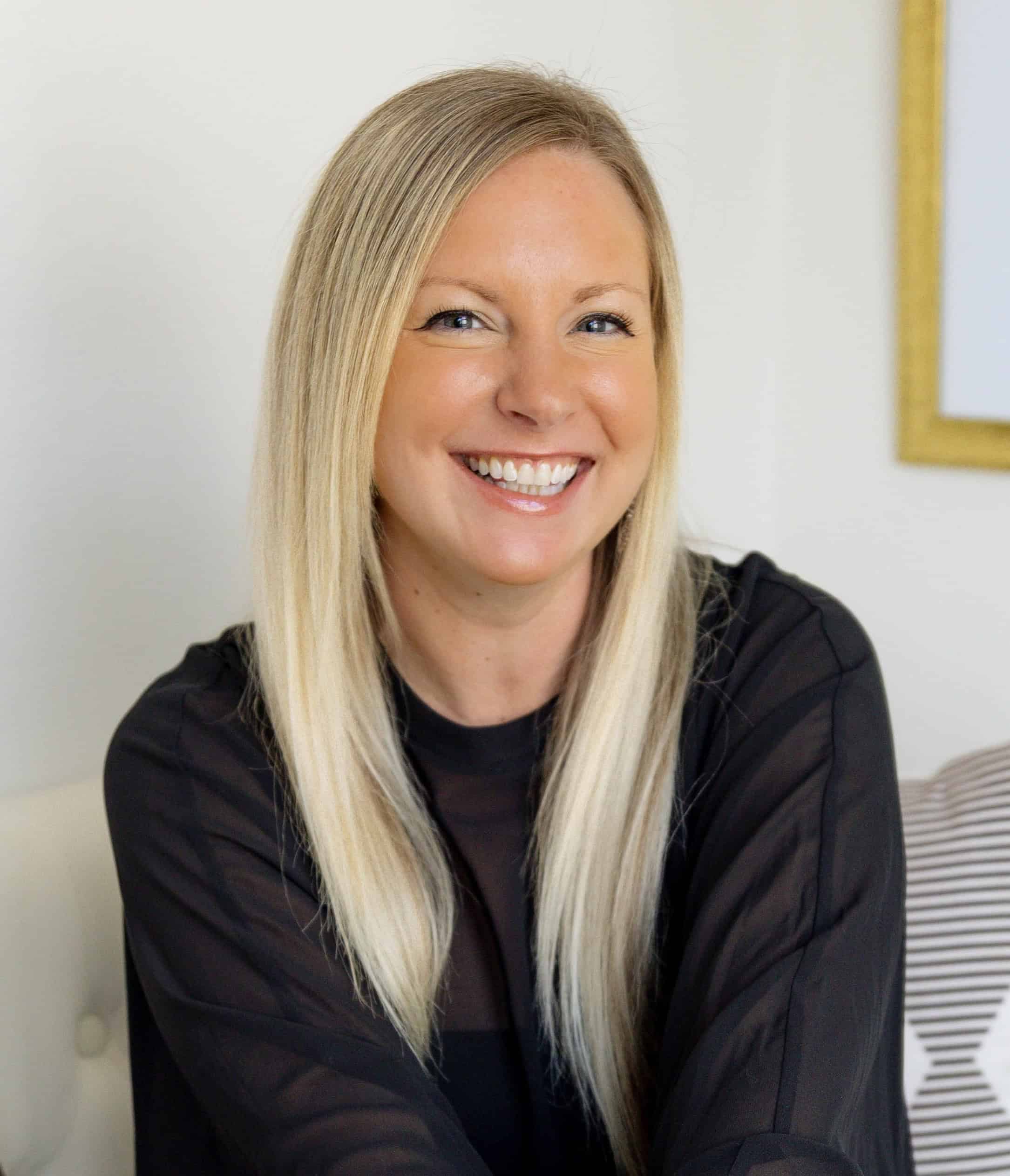
Karli Jaenike is the Fractional Organic Content, SEO and AI Search Strategist behind Wild Idea, where she helps growth-stage companies turn deep internal expertise into content that search engines rank and AI systems cite. She has 10+ years across editorial strategy, SEO, and content systems, including leading SEO content at Eventbrite and working with enterprise clients at Siege Media. Her framework, Authority Engineering, surfaces the knowledge already inside a company, structures it for both traditional search and AI discoverability, and uses AI-assisted workflows to produce and distribute it at scale. She writes After the Algorithm, a weekly newsletter on AI search and SEO. Based in Texas, she’s a nature lover, live music fan, and travel enthusiast.