One interview = many assets. A content strategy that compounds on every surface Google and AI search already trust.
Here’s a pattern I’ve seen a lot recently. A scientific or health-leaning brand has a wonderfully credentialed expert on their team, someone who has contributed to external studies, speaks at conferences, etc., and the brand’s website isn’t piggybacking on that expertise. This is SUCH a missed opportunity.
The content they’re publishing instead is fine (sometimes, it’s not). But the point is that the content could have come from anywhere. It doesn’t have a unique point of view, and it’s certainly not authoritative.
And they wonder why their content isn’t ranking in Google or being picked up by AI search.
Google and AI systems are both getting significantly better at distinguishing between content that demonstrates genuine expertise and content that merely approximates it, and brands without a real expert voice are starting to feel it in their rankings.
Here’s what we’ll dive into today: why your expert’s existing off-site credibility is the most underused asset in your content strategy, and the five-step framework I use to get it onto the web in a form that compounds for both Google and AI search.
The authority is already there; it’s just severely underutilized.
These brands typically have these experts on staff to advise on the product, or to help create studies, or maybe visibility at physical events like conferences. Then why, oh why, are they not leading with their expertise in their content programs?
That invisibility has a measurable cost. Google’s December 2025 core update was pretty unambiguous about it: generic content without genuine expert insight saw traffic losses of 60–80%, while sites with first-hand knowledge and real expert contribution saw gains.
Google has been trying to filter for this kind of expertise for years, and it’s only getting better.
AI search is even less forgiving, because these systems won’t connect that expert’s authority with your brand unless it’s published and crawlable on the web.
How Google and AI actually read authority
Here’s the part that surprises most people: Google has said clearly that author bylines are not a direct ranking factor. So how the heck does it know that your article has authority?
The content itself. Specifically, what the content contains — the specificity, the entity signals, the first-hand language that only someone with real experience would produce.
A clinical observation only a practitioner would make, or a position only someone who’s run the research would reach. That’s what registers as authoritative, and it’s exactly what a well-run SME interview produces by design. Not because of who’s named in the byline. Because of what ends up on the page.
AI systems work the same way, and they’re pulling from very specific surfaces.
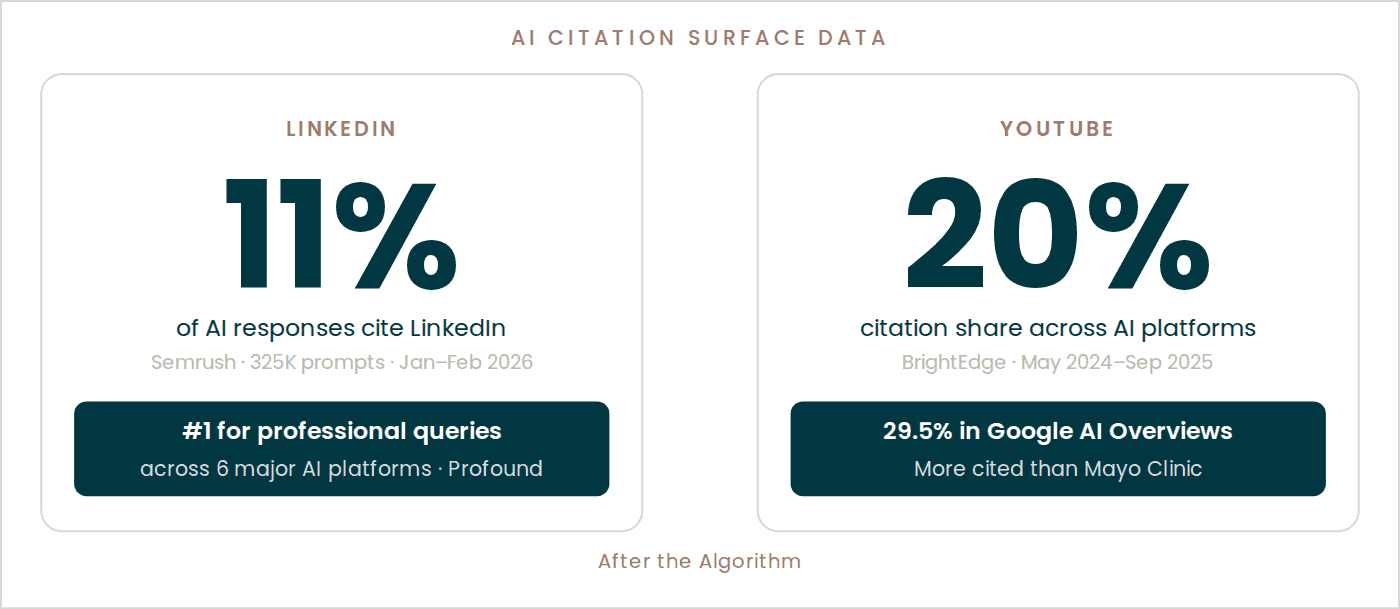
Semrush analyzed 325,000 unique prompts across ChatGPT Search, Google AI Mode, and Perplexity and identified 89,000 LinkedIn URLs cited in AI-generated responses (January–February 2026). LinkedIn came back as the second-most-cited domain across all three platforms, appearing in 11% of responses on average — ahead of Wikipedia and every major news publisher.
A separate Profound analysis tracked 1.4 million citations across six AI models and found LinkedIn is the most-cited domain for professional queries specifically, across every major platform.
YouTube is the other surface worth building on. BrightEdge’s analysis (May 2024–September 2025) found that YouTube averages 20% citation share across AI platforms and 29.5% in Google AI Overviews alone, cited more than Mayo Clinic and Investopedia. A
Goodie AI and Adweek study of 6.1 million citations found YouTube’s share of social citations in AI doubled in just four months.
These are the surfaces AI already trusts. Authority Engineering via the Web of Authority Framework is a system for getting your expert’s knowledge onto all of them from a single interview.
The Web of Authority: How It’s Built
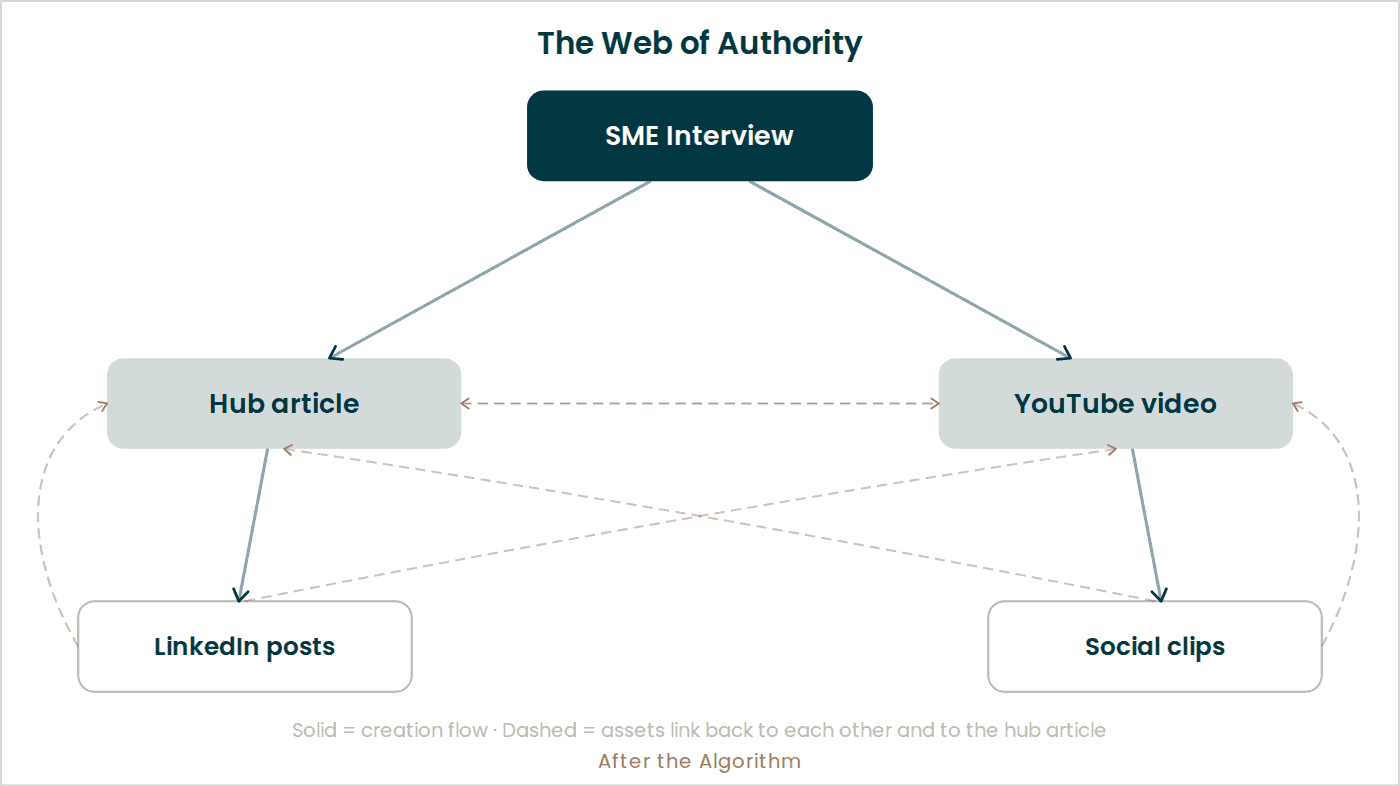
This is the Authority Engineering method I’ve put together to systematize the distribution of your subject matter experts’ knowledge in a way that Google and AI can find. I call it the Web of Authority Framework.
Step 1: The SME. Start with authority that already exists.
Identify someone within your company who already has recognition built off-site — a conference speaker, a published researcher, a clinically credentialed practitioner whose reputation exists independently of your brand.
That existing credibility is the raw material. When their knowledge shows up on your owned channels, it carries weight your brand couldn’t manufacture on its own.
Aside from the credibility they’ve already built, they have something else you can utilize: a genuine POV.
Almost every expert worth interviewing has a specific position on their subject, something differentiated enough from conventional wisdom to make the content actually interesting rather than just more credentialed. That’s what makes the piece useful to a reader and distinctive in a crowded space.
Worth noting: if the expert already has off-site authority, you’re amplifying something that already exists, amazing! That’s a faster path to recognition. If they don’t have it yet, you’re building from scratch, which works fine and just takes longer.
Step 2: The interview. One sourcing session can get you material for many content pieces.
The interview is the engine of the whole framework, and you need to be intentional with it. Do your research beforehand. What’s the intent of the article? What is the general consensus that could be challenged? Where can you pry out the interesting bits of information?
This interview should serve as a structured sourcing session designed to elicit the expert’s clinical perspective, their specific POV, and observations only they would make. 30-minutes to an hour of their time can produce the raw material for several “pillar” assets. They don’t need to write anything; they just talk.
Step 3: The hub article, where expertise becomes searchable.
From the interview, you build a long-form, SEO and AEO-optimized on-site article shaped by the expert’s quotes and perspective. The article doesn’t need to be ghostwritten in their voice (though it could be), but it’s structured around their insights, which makes it useful to readers and cite-worthy for an AI system.
This is also where the E-E-A-T signals actually live. Not in the byline — in what the content contains. The specific language, precise framing, and clinical detail that only comes from someone who’s actually done the work.
Step 4: The video, same expertise, second surface.
The interview questions get adapted into a script, and the expert records a YouTube video. They’re not starting from scratch, which helps when someone is busy and only has a few minutes to record.
They’re answering questions they already worked through, just on camera. That video gets embedded directly in the on-site article. That way, the article has multimedia, and there’s another surface for the expertise to be found.
Step 5: The distribution layer, all interlinked.
The article can then be summarized into 2-3 LinkedIn posts (this is where AI comes in super handy). The YouTube video is converted into shorter social clips (which can be posted on your social platform of choice). And everything interlinks: the article is linked in the video description, the posts link to both, and the clips drive back to the full video.
This isn’t just a distribution plan; it’s a signal architecture. A Stacker study from December 2025 found that distributing content across multiple platforms can increase AI citations by up to 325% compared to publishing only on your own site.
Common objections
“Our experts are too busy.”
If you’re asking them to write something, they probably are. Writing is slow, it pulls people out of the work they’re actually there to do, and for someone whose expertise is clinical or technical, producing polished prose is a bit of an imposition.
This framework doesn’t ask them to write anything. It asks them to talk.
One structured interview produces every asset in the chain. The content team (with a little AI-assisted magic) handles everything from there.
The expert just needs to show up, answer questions they already know the answers to, and that’s it. Too many people place the burden on experts, so they never get the input they’re looking for. Treat them like a source, and yourself as a reporter, and it’s a much easier yes.
The window is still open, but not for long
Profound’s data showed LinkedIn’s domain rank in ChatGPT citations moved from approximately number 11 in November 2025 to number 5 by February 2026, in three months. Most brands haven’t adjusted their content strategy to account for it, which means those moving now are gaining an advantage on surfaces that are getting more competitive every quarter.
I ran a version of this framework with a wellness brand, a smaller execution, but the same mechanism. We chose one credentialed expert, asked her for one interview a month, and shaped priority content based on her clinical perspective. We then created a YouTube video built from the same questions. We didn’t even involve the other channels at this point, and organic blog traffic increased 154% in 90 days (we were also rolling in the AI citations almost immediately).
The interview is where the real work is: finding the right expert, building enough trust to get something genuinely useful out of them. Everything after that is execution.
If you have an expert on your team and you’re not using them yet, that’s the gap worth closing first.
If you want help building this out: the interview framework, the AI-assisted content architecture and distribution layer, that’s exactly the work I do with fractional clients. Reach out, and let’s build you a content engine!
Karli Jaenike is the Fractional Organic Content, SEO and AI Search Strategist behind Wild Idea, where she helps growth-stage companies turn deep internal expertise into content that search engines rank and AI systems cite. She has 10+ years across editorial strategy, SEO, and content systems, including leading SEO content at Eventbrite and working with enterprise clients at Siege Media. Her framework, Authority Engineering, surfaces the knowledge already inside a company, structures it for both traditional search and AI discoverability, and uses AI-assisted workflows to produce and distribute it at scale. She writes After the Algorithm, a weekly newsletter on AI search and SEO. Based in Texas, she’s a nature lover, live music fan, and travel enthusiast.




Related Posts:

YMYL SEO in the Age of AI Search: Why Expert-Backed Content Wins Where Trust Is Non-Negotiable

Authority Engineering: How Brands Get Cited in AI Search

Rebuilding My Content Workflow in Claude Code, Part 2: What It Can Do and the One Input It Can't Fak...