If a journalist needed to cite your brand today, could they find what they needed? AI is asking the same question.
There’s a useful way to think about how AI citation works: imagine a journalist on deadline looking for a source.
They’re not reading your whole blog. They’re scanning for whoever has the clearest authority or the most specific number to cite. The person who made it real easy to grab a quote.
If your content is built to make the journalist’s job easy, you’re in the story. If it’s a wall of paragraphs with no attributed voice and no specific numbers, original stats, or unique claim, they move on.
AI retrieval works almost identically. And like a good journalist, it’s getting harder to fool.
How AI decides what to cite
Most AI tools use a process called retrieval-augmented generation, a framework coined by researcher Patrick Lewis in 2020. When someone asks a question, the model pulls relevant chunks of content from across the web, synthesizes them into an answer, and (sometimes, not always) attributes what it used.
The way I read the research, what determines which chunks get pulled comes down to two things: whether the content is structured for extraction, and whether it’s credible enough to repeat.
Content that’s already formatted in a way that AI produces is easier to grab because it’s the lowest-friction answer. This means formatting your content in easily citable ways, like direct comparisons, a specific stat + source, or a clear Q&A.
Dense paragraphs where the point is buried somewhere in the middle aren’t necessarily wrong. They’re just inefficient for retrieval.
What content formats get cited most in AI search
The Digital Bloom’s 2025 AI Citation and LLM Visibility Report, which synthesized data from over 680 million citations across platforms, found that comparative listicles account for 32.5% of all AI citations, the highest share of any content format.
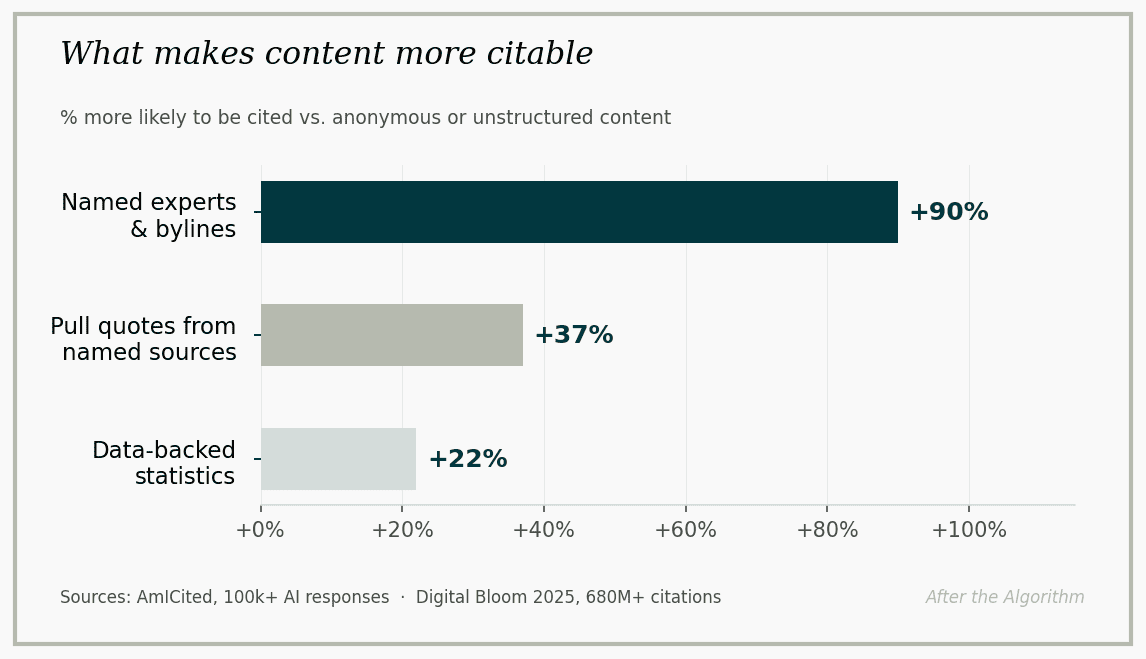
The same report found that adding data-backed statistics increases AI visibility by 22%, and articles with pull quotes from authoritative named sources see a 37% lift.
If you’re thinking you’ll just start writing more listicles, approach with caution. You don’t want to risk a Google penalty for a chance at an AI citation.
In her February 2026 analysis, Lily Ray documented brands that had built large libraries of self-promotional “best of” content, lists in which they ranked themselves first, with no independent methodology or third-party evaluation, took serious hits in Google search in January 2026. Some lost 30 to 50% of their organic visibility, with the loss concentrated in their blog content.
Her note when she shared the research: objective third-party lists were holding strong.
What Lily Ray’s data could show is that the format isn’t necessarily the problem. The brands that were affected used the format as a shortcut, ranking themselves first without a clear methodology, and Google recognized that. Genuinely helpful, data-backed lists are likely not seeing the same hits.
What makes content actually citation-worthy
Think about the last thing you forwarded to a colleague. It likely contains a new stat, study or opinion from someone you respect. AI citation logic runs on the same reasoning.
A few things that act as a sort of citation cheat-code:
-
Named experts with real credentials. AmICited’s analysis of over 100,000 AI-generated responses found that content with attributed bylines and named subject matter experts earns 1.9x more citations than anonymous content. When a real person with real credentials says something specific about your topic, that statement is citation-worthy in a way that more general claims will never be.
-
Original data, even when it’s internal. Your client results, your own testing or a survey your team ran. Specific, real-world findings outperform general assertions, even well-written ones. You don’t necessarily need a formal study, just a real number with a credible source behind it.
-
Your best insight in the first 30%. Kevin Indig‘s February 2026 analysis of 18,012 verified citations from 1.2 million ChatGPT responses found that 44.2% of all citations come from the first 30% of a piece. If your most citable point is buried in section four, it might be getting skipped by AI (and by the human who clicked into the article). This is where TL/DR or summary sections work great at the beginning of a piece.
One more thing worth doing: write each major section as a standalone unit. If someone landed in the middle of your article with no context, would they be able to gain valuable information? If the answer is no, you might want to make things a little more scannable.

A great writer? Still an absolute necessity.
Whenever I or anyone else is talking about optimizing for AI (and honestly, this carries over from conversations I’ve had about search engine optimization as well), I tend to hear: “I don’t want to create content for AI. I want it to be helpful and interesting for actual people.”
And I’m always like — duhhh. Of course!
I’m not sure where people got the idea that creating optimized content meant that it had to be soulless, but it’s a misconception I’m constantly fighting against.
When done right, the credibility signals above make content more persuasive to humans, too. A well-sourced stat is more convincing to a reader than a vague assertion. An expert quote is more interesting than a generic tip.
Building for citability and building for humans aren’t opposing goals.
What structure and credibility can’t do is make boring content worth reading. This is where a skilled writer comes in. They turn “our analysis shows X” into something a person actually wants to read past the first sentence.
The SME and the sourced data provide the knowing. The writer makes it worth a human’s time.
And ultimately, you’re creating this content so that a human takes an action: clicks through, reaches out, or trusts you enough to buy. So, once someone discovers your brand (through AI, Google, or wherever), when they actually interact with your content, it’s got to be good enough to earn an action.
Thoughts? Something you’re testing on your own content? Let me know in the comments!

Karli Jaenike is the Fractional Organic Content, SEO and AI Search Strategist behind Wild Idea, where she helps growth-stage companies turn deep internal expertise into content that search engines rank and AI systems cite. She has 10+ years across editorial strategy, SEO, and content systems, including leading SEO content at Eventbrite and working with enterprise clients at Siege Media. Her framework, Authority Engineering, surfaces the knowledge already inside a company, structures it for both traditional search and AI discoverability, and uses AI-assisted workflows to produce and distribute it at scale. She writes After the Algorithm, a weekly newsletter on AI search and SEO. Based in Texas, she’s a nature lover, live music fan, and travel enthusiast.




Related Posts:

YMYL SEO in the Age of AI Search: Why Expert-Backed Content Wins Where Trust Is Non-Negotiable

Authority Engineering: How Brands Get Cited in AI Search

Rebuilding My Content Workflow in Claude Code, Part 2: What It Can Do and the One Input It Can't Fak...