The data on AI citations is real. The conclusion most people are drawing from it isn’t.
The “owned content is dead” narrative has been making the rounds lately. And ya know what? It’s being repeated confidently enough, by enough smart people, that I couldn’t just scroll past it anymore.
The argument goes like this: AI draws pretty exclusively on earned mentions, third-party citations, and press coverage. Your on-site resource content plays a very small role. If you’re investing in a blog, a resource hub, a content program — you’re basically shouting into the void.
I’ve built my career around content and SEO. As AI search becomes a bigger part of my day-to-day, I’m constantly digging into the research to make sure my thinking is keeping up with what’s actually happening. So when this one kept coming up, I did what I always do: went looking for the data.
Spoiler: it’s complicated. But in a good way.
The data everyone’s citing
Muck Rack’s Generative Pulse report analyzed millions of AI prompts and found that earned media overwhelmingly drives AI responses: third-party citations, press coverage, and non-brand-owned sources dominate what AI actually surfaces.
Stacker ran a controlled study in partnership with Scrunch and found third-party distribution produced a 239% median lift in AI search visibility compared to brand-owned content alone. Worth noting: an earlier, smaller version of the same study found lifts as high as 325%.
The PR in me gets a little excited reading this, but the content marketer is decidedly less so. The data is there: earned media does dominate AI citation influencing. Anyone telling you otherwise is working with incomplete data.
And you know what? That’s OK. Measuring on-site, owned content as a purely GEO play was always selling it short.
What owned content does is make everything else possible: it builds your organic search presence, establishes the body of evidence that earns/reinforces third-party citations, and turns your internal experts into known entities that AI systems can actually find and verify.
Earned citations don’t appear out of thin air
The brands getting cited in earned media didn’t just magically wake up with the authority to speak in these publications.
They likely started with an internal expert, and built credibility through owned expert content specific enough, credible enough, and clearly attributed enough that a journalist, a trade publication, or an industry newsletter could find them.
Heck, the publications could even have pulled the quote or data directly from owned content already out there!
AuthorityTech put it plainly: owned content becomes stronger when it acts as a reference layer for third-party corroboration rather than a lone assertion. It’s one piece of a massive web of authority being built about a person or brand.
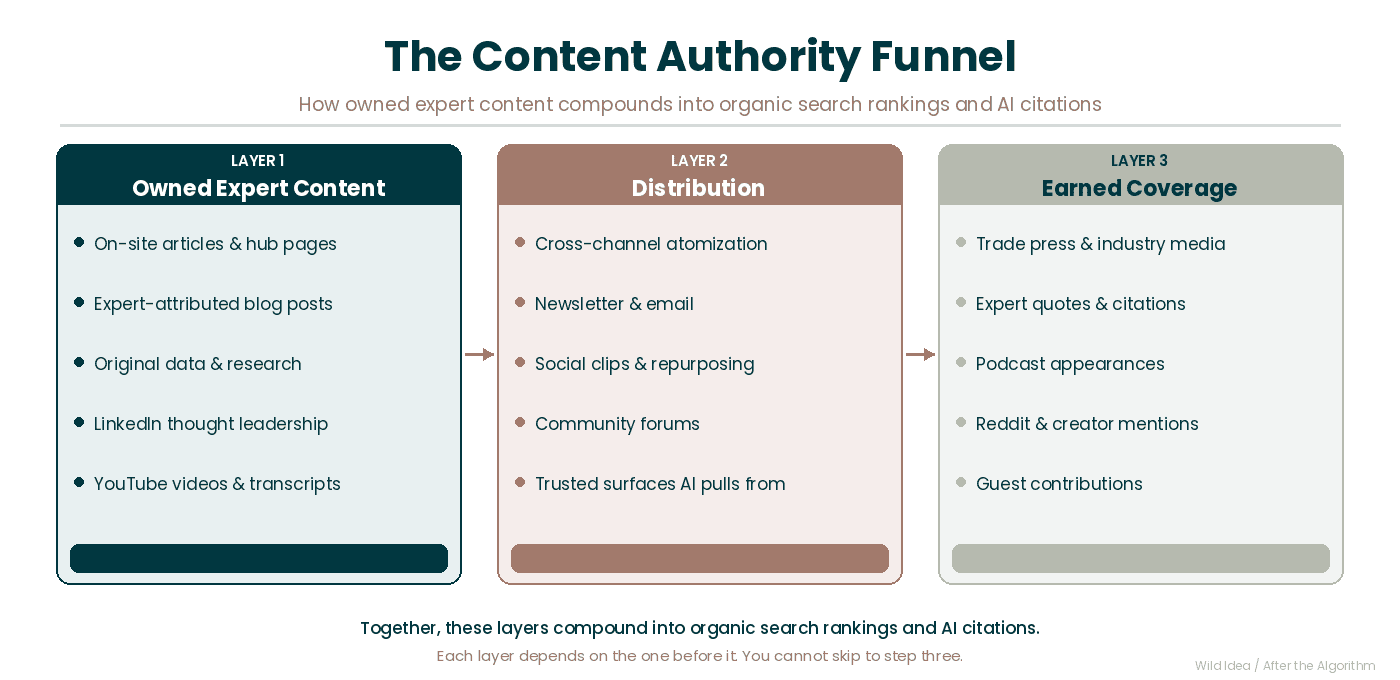
The process looks like this: owned expert content (on-site, or on owned channels like LinkedIn or YouTube) gets distributed across the surfaces AI already trusts, building citation surface area. This, often, ends up building the authority that earns third-party coverage — and that’s when the whole system really starts to compound.
Each layer depends on the one before it, and they all work together to reinforce one another.
Here’s what that looks like in practice. A wellness brand’s medical director has spent years developing a specific clinical protocol around metabolic recovery. That knowledge lives in her head, in staff training decks, and as unattributed numbers and stats on landing pages.
When a journo is looking for an expert to cite, interview or quote, that wellness brand is not going to be on their radar. They’d need to pitch the publication to get that mention, and even then, when the journalist goes to verify the source is credible, she won’t find much.
On the flip side, in another universe, that wellness brand’s content team has built up the medical director as the authority on the subject. She’s contributed to studies and their resource hub is full of snackable stats to pull. Her point of view is well known and ranking for top industry keywords. She’s built a presence alongside the brand on LinkedIn, and has been featured on their YouTube channel.
Who do you think is going to get the most media attention?
Build that foundation first, cross channel. If you have internal data or a study journo’s can reference without ever having to reach out? Even better.
And the cherry on top of this content cake: that owned content is doing double, triple duty. Because (if you’re doing it right) the pieces that live on-site are optimized for SEO, ranking, and bringing in organic traffic, AI search aside.
The data on what happens when owned content disappears further reinforces this point. Researchers examined eleven websites affected by a 2026 Google algorithm update. Every single site that lost organic visibility also lost AI citations, an average drop of 22%, and in some cases the citation decline was larger than the organic traffic loss itself.
The channels aren’t decoupled. Lose ground in search, and you are likely to lose ground in AI simultaneously.
This.👏 Is.👏 A.👏 System.👏 That.👏 All.👏 Works. 👏Together.👏
Looking at the entire picture
Here’s the part that gets glossed over in the hot-take version of this narrative.
Journalists absolutely do reach out to experts directly for interviews. But how do they find those experts in the first place, and what makes them decide someone is worth quoting?
Muck Rack’s 2026 State of Journalism report, based on surveys of nearly 900 journalists, found that 58% trust LinkedIn above any other platform, and 40% say original data or research is what makes a pitch genuinely relevant. Nearly 90% delete pitches that miss their beat entirely.
A bylined article, a LinkedIn post, a study. Something the journalist found, read, and decided meant this person has something worth quoting. That body of evidence doesn’t appear out of nowhere. It gets built, deliberately, through owned content published over time.
Contently’s research on how AI citation works adds another layer: AI search engines weigh mentions of the author across the entire web when deciding what to cite. Generic bylines give engines nothing to verify. Named authors with real, demonstrable expertise help brands survive the citation filter.
Which means the AI citation attributed to a trade publication is, in part, evaluating the expert whose knowledge made that piece citable in the first place.
Where the expertise originates
Content Marketing Institute’s 2026 B2B research surveyed over 1,000 B2B marketers and found that 96% of companies produce thought leadership, but only 37% have employees with specialized knowledge actively contributing to it.
Nearly 75% of enterprise marketers say fewer than 15% of their internal subject matter experts contribute at all. That gap between “we create thought leadership content” and “our actual experts are involved” is exactly where AI visibility breaks down.
Generative engines are looking for evidence that the expertise is real, documented, and independently verifiable. Generic content — especially content that could have been produced by AI itself — gives engines nothing to verify and no reason to cite.
And here’s the thing: this isn’t new criteria invented for AI search. These are the same signals Google has been rewarding for years. Firsthand experience, specific claims and real expertise demonstrated through the content itself. Google’s December 2025 core update just made the cost of ignoring it impossible to overlook.
Sites producing content without genuine expert insight saw traffic losses of 60-80%, while sites with real expert contributions saw gains. Build content around genuine expert knowledge, structure it clearly, attribute it to a real person, and you’re not choosing between SEO and AI visibility. You’re earning both simultaneously.
I see this constantly in expert-led brands. They have a real wealth of knowledge on staff. They might even have internal data or studies they have conducted.
The blog exists, articles go up on a reasonable cadence, and the content is fine. But it could have come from anywhere. There’s no clinical voice in it, no named expert behind it, nothing an AI system could cross-verify against an independent source.
The knowledge is there. It’s just trapped. In staff trainings, internal protocols, a Slack thread where the medical director just explained something brilliantly to a new hire. None of it is on the public record, which means none of it exists to AI.
That’s the credibility gap. The fix is getting that specific, proprietary, experiential knowledge out of someone’s head and onto the surfaces where AI can actually find it.
So where does owned content shine?
Let’s be direct about this. Owned content may not be the primary driver of your AI mentions. That’s not what it’s built for, and measuring it against that yardstick is setting it up to fail.
What it actually does — when it’s built right — is three still-very-important things.
It builds your organic search presence. Organic search still drives 53% of all website traffic. That’s not a channel in decline; it’s the channel that pays the bills while everything else compounds. Expert-attributed, search-optimized content is still the most reliable way to own that traffic.
It turns your internal experts (and/or your brand) into known entities. AI doesn’t discover unknown brands, it selects from entities it already understands to be credible.
Ahrefs’ analysis of 75,000 brands found brand web mentions correlate with AI citation rates at 0.664, roughly three times stronger than backlinks. A named expert with a body of published work, consistent positioning, and a presence across multiple surfaces is a known entity. A brand with a blog full of unattributed articles is not.
It’s the foundation that makes your brand credible. Third-party publications, industry newsletters, journalists looking for a credible expert to quote, and none of them can reference a perspective that doesn’t exist on the public record yet. Owned content is what gives them something to find, and the brand it’s recognition.
So does owned content still matter?
Yes, of course! …with one condition.
Generic owned content is losing ground fast. The optimization instinct (add schema, restructure headers, use answer-first format) won’t save content that had nothing worth citing in the first place.
Content that could have been written by anyone, about anything, citing nobody in particular, is exactly what AI systems are learning to avoid.
Expert-attributed owned content is a different asset entirely. That’s what ranks in search, builds your brand’s body of evidence over time, and creates the conditions for everything else to compound.
Here’s what all the noise about owned content being dead is really telling you: the bar has been raised. Crappy owned content is dead (and tbh it has been for a while).
Generic content without a real expert behind it was always a weak asset. It ranked inconsistently, converted poorly, and built nothing over time. AI search just made that more obvious.
The brands winning right now aren’t doing something revolutionary. They found the people inside their organization with deep knowledge, got that knowledge out of their heads and onto the web in a form worth citing, and let it compound.
That’s been the play for years. It just matters more now.

Karli Jaenike is the Fractional Organic Content, SEO and AI Search Strategist behind Wild Idea, where she helps growth-stage companies turn deep internal expertise into content that search engines rank and AI systems cite. She has 10+ years across editorial strategy, SEO, and content systems, including leading SEO content at Eventbrite and working with enterprise clients at Siege Media. Her framework, Authority Engineering, surfaces the knowledge already inside a company, structures it for both traditional search and AI discoverability, and uses AI-assisted workflows to produce and distribute it at scale. She writes After the Algorithm, a weekly newsletter on AI search and SEO. Based in Texas, she’s a nature lover, live music fan, and travel enthusiast.