We’ve established that owned content still matters; now we’re going to talk about what to actually do with it, and why the answer isn’t the same for everyone.
If you read last week’s issue, you already know the “owned content is dead” narrative doesn’t hold up. The research is pretty clear on that.
So let’s skip ahead to the more interesting question: if owned content matters, what do you actually do with it? In what order?
What is the order of operations to truly move the needle? Is there even an order of operations?
So many questions.
As I was pulling this together, the guys at Grow and Convert dropped a new episode covering almost the exact same ground — pushing back on the “third-party content drives everything, on-site doesn’t matter” narrative. It’s definitely worth a listen as complementary content!
Their findings, based on real client data, add a layer to this conversation that I’m going to explore here.
The stat everyone keeps misreading
Quick recap for anyone who missed last week: 82–94% of AI citations come from earned media. That means third-party placements, press coverage, and non-brand-owned sources. Muck Rack and AuthorityTech have both confirmed it.
If you’re measuring AI visibility, earned media is a huge piece of that pie.
However, the conclusion a lot of brands are drawing from this is wrong: skip owned content and concentrate all efforts on offsite.
We don’t want to do that, for so many reasons. First (and I’m going to keep saying this until I’m blue in the face), SEO still accounts for about 50% of web traffic, and owned/onsite content is where that organic traffic comes from.
Secondly, even as a purely AEO play, on-site and owned content contribute to the web of authority you’re building. How can you build a brand off-site if you don’t have a strong owned POV first? What will AI use to corroborate authority? What will a journo?
Now that we’ve recapped, let’s dive deeper into practice, weaving in the findings from Grow and Convert.
Data showing owned content is driving LLM mentions
The Grow and Convert team isn’t theorizing. What they found challenges the idea that on-site content is irrelevant to AI brand mentions, backed by data.
For two clients in specific niches (a workforce training company and a trucking software startup), owned content was driving a meaningful share of LLM brand mentions, even before any earned media work. These aren’t household names with incumbent brand awareness; they’re smaller brands in categories where good content is fairly sparse.
Their explanation makes sense: in a less competitive space, a well-written, expert-attributed piece of owned content can surface in AI answers almost on its own, because there’s not much else for the model to pull from.
The bar is lower, and original content is the best source to pull from.
Saturated categories are a different story: spaces like “best CRM software” with hundreds of third-party articles, review sites, and comparison pages all saying roughly the same things about the same brands. In those categories, owned content alone doesn’t move the needle much because the LLM already has dozens of corroborating sources and your site is one voice among many.
The strategic implication is worth a tweak in strategy: how aggressively you need to pursue earned amplification depends heavily on how crowded your category is.
The truth is, we’re all just figuring this out
Grow and Convert also flagged something I think deserves more airtime. We don’t actually know how LLMs decide what to recommend.
There’s emerging, still-unpublished evidence suggesting that models may first form an answer from training data, then find sources to support it after the fact — which would mean the citation patterns we’re all analyzing aren’t the clean causal signal we’ve been treating them as.
They’re careful about this, and I think that caution is right-on. The studies we have, including the ones cited in this newsletter, are observational.
What we can say with a fair amount of confidence: brands with a stronger published presence, more surfaces, more attributed expertise, show up more.
I think this is likely due to a stronger brand presence, but it could also be because it shaped the training data or because it corroborates a response the model already wanted to give. It’s still unclear. Perhaps it’s some combination.
Here’s how I’m thinking about it
Despite all the uncertainty, treating AI search strategy like a funnel makes the most sense right now. Establishing the foundation with an owned-brand perspective is a great first step.
A journalist quotes a founder because that founder has already articulated a position somewhere. A podcast invites someone on because they’ve read what that person has written (or showcased in their brand somehow).
Owned content is also doing its own work independently: building organic search presence (which still accounts for ~50% of all web traffic, versus roughly 0.15% for AI platforms), turning internal experts into known entities AI systems can find and cross-verify, and creating the body of evidence that makes a brand credible before any journalist comes looking.
The third-party placement adds what owned content alone can’t produce: independent corroboration. When an external source references your expert’s position, it tells AI that someone besides you thinks this perspective is worth citing. But how urgently you need that layer depends on where you’re starting from.
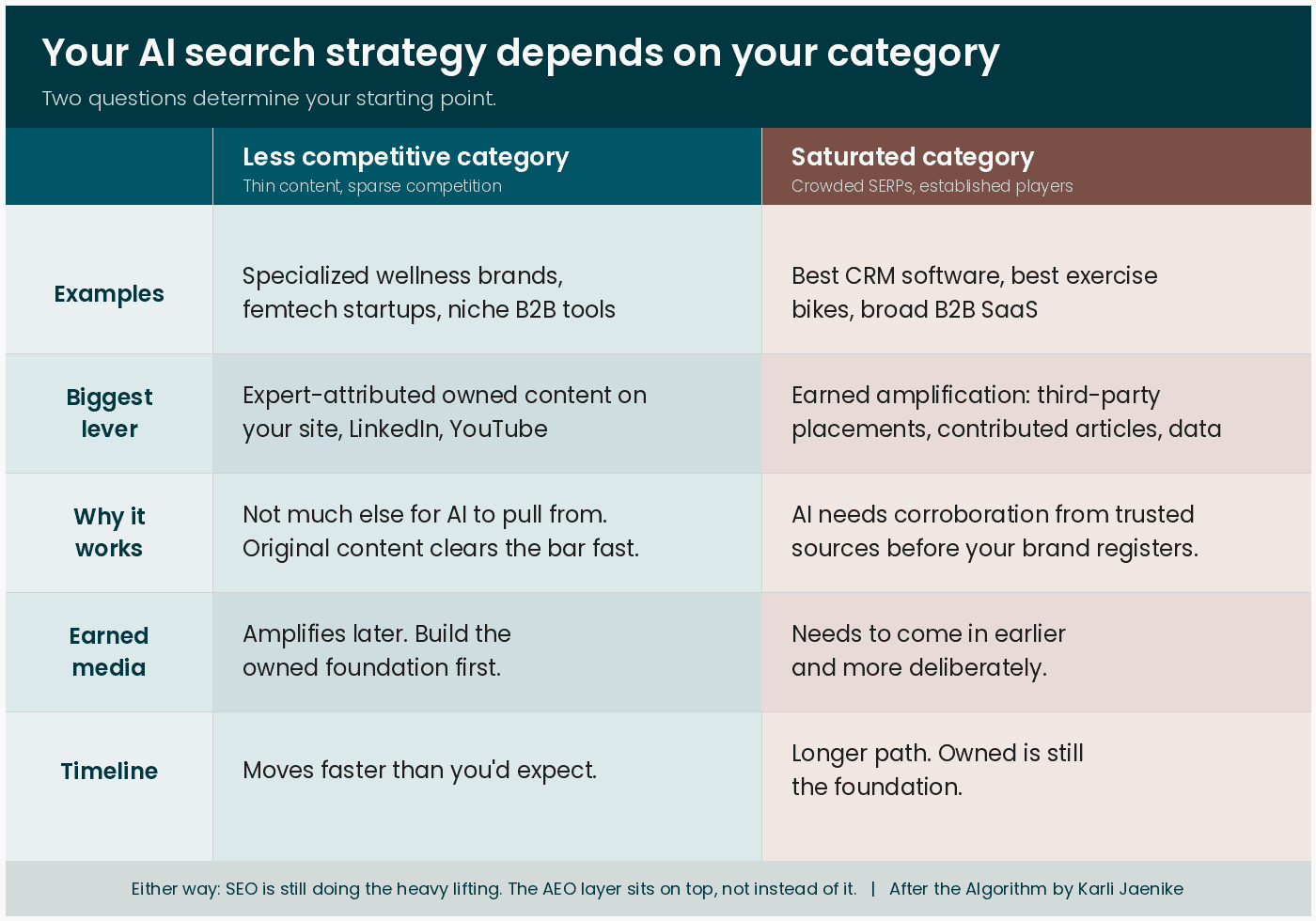
Think of it as a diagnostic. Two questions:
How crowded is your category?
If you search your core topics and find thin, outdated, or generic content dominating the results, owned content is a huge lever. Get expert-attributed content onto every surface AI reads — your site, LinkedIn, YouTube — and you can move the needle faster than you’d expect.
If your SERP is stacked with established players and third-party review sites, owned content is still the foundation, but earned amplification needs to come sooner.
How established is your brand’s public presence?
A brand with a recognized founder, existing press mentions, or a credentialed practitioner already active on LinkedIn is starting from a very different place than one with no published expert presence at all. For the latter, layer one isn’t optional; you need to manufacture the authority you don’t have.
Either way: SEO is still doing the heavy lifting for actual traffic. On-page strategy, technical health, content architecture — none of that changes. The AEO layer sits on top of it, not instead of it.
The interview framework, the content architecture, the distribution layer, that’s what I build for fractional clients. If you’d like one for your very own site, get in touch.

Karli Jaenike is the Fractional Organic Content, SEO and AI Search Strategist behind Wild Idea, where she helps growth-stage companies turn deep internal expertise into content that search engines rank and AI systems cite. She has 10+ years across editorial strategy, SEO, and content systems, including leading SEO content at Eventbrite and working with enterprise clients at Siege Media. Her framework, Authority Engineering, surfaces the knowledge already inside a company, structures it for both traditional search and AI discoverability, and uses AI-assisted workflows to produce and distribute it at scale. She writes After the Algorithm, a weekly newsletter on AI search and SEO. Based in Texas, she’s a nature lover, live music fan, and travel enthusiast.