Most SEO briefs are just a keyword and a word count. Here’s what a brief that actually does the work looks like.
Every content team has a briefing process. Most of them are trash.
A keyword, a target word count, maybe a vague note about the audience. Then the writer — human or AI — is left to figure out the rest. They fill the gaps with information they’ve gathered from around the web, which usually just regurgitates what everyone else is already saying.
A brief’s job is to transfer strategic thinking to the person doing the writing in a clear way, so that you’re taking the burden off of the writer to decide what to include and why. If that transfer doesn’t happen, the writer is left flying blind. They aren’t mind-readers. If you want a piece of content to land in a specific place, you need to be explicit with your instructions.
Here’s what I mean by “strategic thinking,” and why it belongs in the brief.
The section most SEO briefs skip entirely
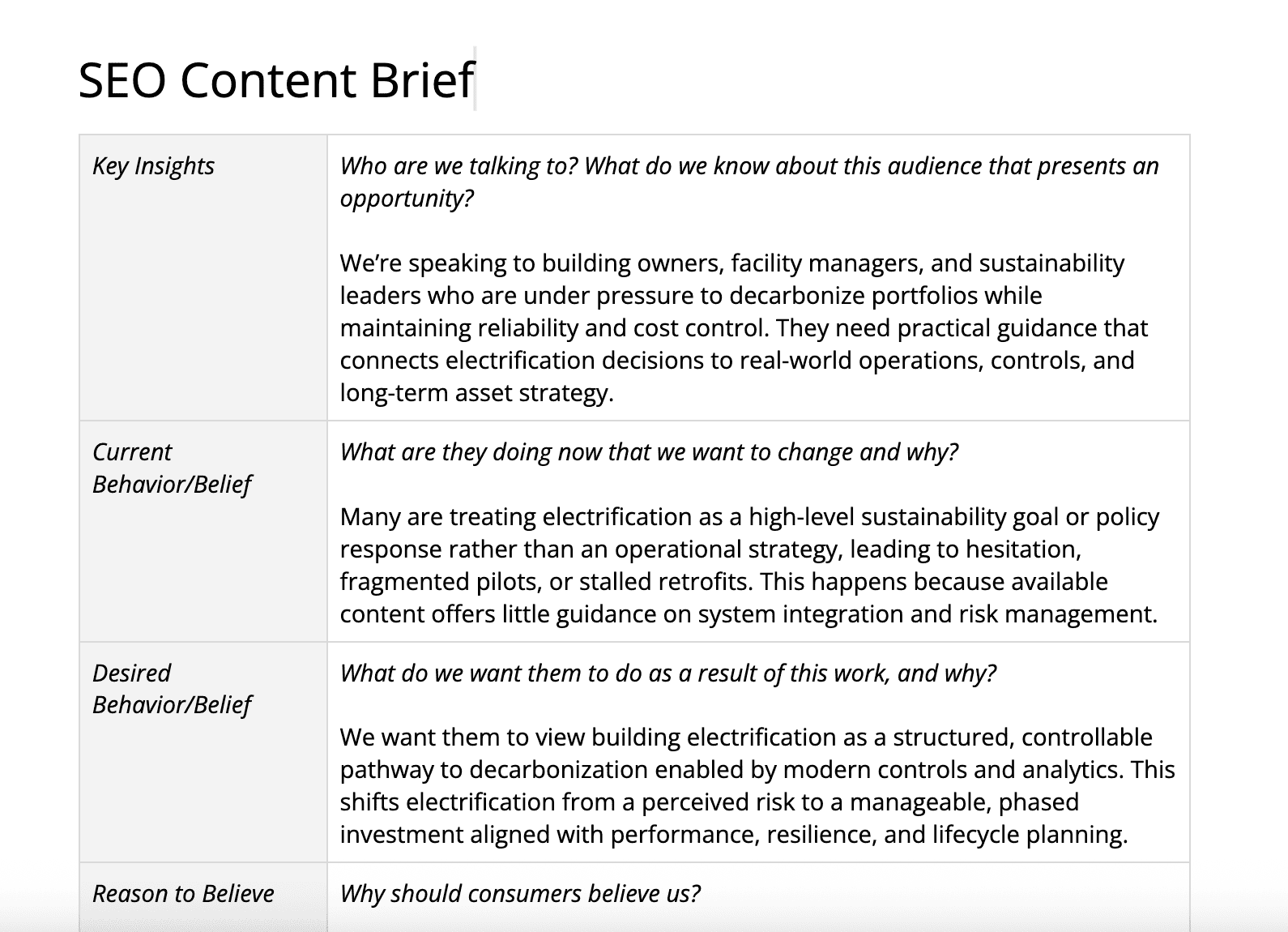
My brief template has an overview section that most SEO briefs don’t include. Four rows: Key Insights, Current Behavior/Belief, Desired Behavior/Belief, Reason to Believe.
The last three are borrowed from brand messaging frameworks I learned during my time at Eventbrite; the kind used to launch products and write positioning documents. I put them in SEO content briefs because the underlying question should be the same: what does this person currently think or do, and what do we want them to think or do after reading this? Every piece of content should be created to lead to a desired action.
When there isn’t an underlying purpose and specific target audience for an article, writers tend to keep things more general and relevant to all. They explain what a thing is, walk through how it works, and cover the basics. The content is technically accurate, but it doesn’t speak to your people.
The Current/Desired Behavior rows insert the directions into the brief, making it easier for the writer to navigate. By the time a writer gets to the first H2, they know who they’re writing to, what that person already believes, and what shift they’re trying to create. It goes beyond helpful context and into the realm of what informs and what persuades.
The question that separates strategy from documentation
There needs to be a section that tells the writer about the search intent and the angle the article should take. That’s the SERP analysis. There’s a field in my SERP analysis section that I haven’t seen in very many other briefs: How will ours be better?
I always fill this in myself. Not because writers can’t think critically about the SERP, but because this is where the strategic call lives. It requires knowing the client, the audience, and the competitive landscape well enough to say: here’s the gap, and here’s how we’re going to fill it. Sometimes it’s easy to fill this gap because we have a unique angle and SME insight. That’s the holy grail. If not, I try to delve deeper (not necessarily longer, but deeper) into a topic. If everyone’s covering the surface, I search for the real answer buried three layers down that nobody’s bothered to get to.
Whatever the answer is, it needs to be in the brief so that everyone, from the writers to the editors to the final QA, can ensure this angle is honored.
What a full brief actually hands off
Beyond the overview and SERP analysis, a good brief should hand the writer a near-complete architecture: the H1, every H2 and H3, notes on what each section should cover, suggested internal and external links, SME quotes or studies to reference; the works.
The writer’s job at that point is to write. Not to figure out the structure, not to decide what’s worth including, nor to guess at the angle. All of that has already been decided.
If it sounds like a lot of work up front, that’s because it is. But it’s work that has to happen somewhere. Either you do it in the brief, where it shapes everything that follows, or the writer does it mid-draft, where it risks wasting their time and yours if y’all aren’t on the same page.
This is especially true when working with remote teams of freelancers or building content at scale.
The brief is even more important if AI is writing the first draft
A human writer can ask a follow-up question. An AI model can’t.
When AI is involved in creating a first draft, everything that would have gone into a phone call or a Slack thread needs to be included in the brief instead. I’ve been using a seven-part framework for this:
-
format (the full outline, not just the content type),
-
topic and angle (the subject plus your specific POV and any SME input),
-
audience (who this is for and what you want them to believe after reading it),
-
structure (length and flow),
-
tone and voice (an actual writer’s guide — who’s talking?),
-
examples and references (past work that the model can match its energy to),
-
and search intent (what the reader is actually trying to accomplish, and what the SERP expects the piece to include).
A well-built brief and a well-built AI prompt are essentially the same document. More on that in a future issue.
A killer brief shouldn’t be a ‘nice to have’; it’s the meat of the work.
Briefing tends to get treated as the thing you do before the real work starts. I’d venture to say it’s the single most important part of the content creation process. It’s where the strategic decisions actually get made and articulated down the chain of operations. If you go deeper during the briefing period, everyone wins. Fewer rewrites, organization and clarity from the start, and it leaves room to super easily interpret SME lived experience into the mix.
When the hard questions are answered up front, the pressure is taken off the rest of the process.

Karli is content marketing consultant behind Wild Idea, a content marketing and SEO collective focused on driving big results. With over 12 years in the marketing industry, she’s worked with brands large and small across many industries to grow organic traffic and reach new audiences. She writes on everything from marketing, social, and SEO to travel and real estate. On the weekends, she loves to explore new places, enjoy the outdoors and have a glass or two of vino!