The prompt is usually the problem, and a good brief is usually the fix.
There’s a version of this that’s probably familiar: you open ChatGPT, type something like “write a blog post about gut health for women,” and what comes back is… fine. Readable.
Sounds like content.
It would never rank for anything, and your actual audience would scroll past it in three seconds, but technically, words were produced.
You curse Claude for a bit — this is going to take longer to edit than it would have been to just write something yourself. You conclude AI isn’t helpful for this use case. But guess what, 9 times out of 10, the problem wasn’t the AI.
It was the prompt.
I’ve been using a content brief system for years, long before prompting became a skill anyone cared about. The brief is where I figure out whom my team is writing for, what we want them to believe by the end, and why they should believe us over anyone else.
Good briefs make good content. Under-built briefs make filler, whether a human or an AI is producing the first draft.
When AI became a real part of my workflow, I spent a long time trying to figure out how it could help speed up my process while still sounding like me, producing a draft I could actually work with.
And here’s one thing I learned: the prompts that got me useful output looked a lot like the content briefs I create for writers.
Lauren deVane built a seven-element prompting framework for image generation, and she shared this at Create and Cultivate a while back. The next weekend, I felt inspired to create a similar one for content SEO.
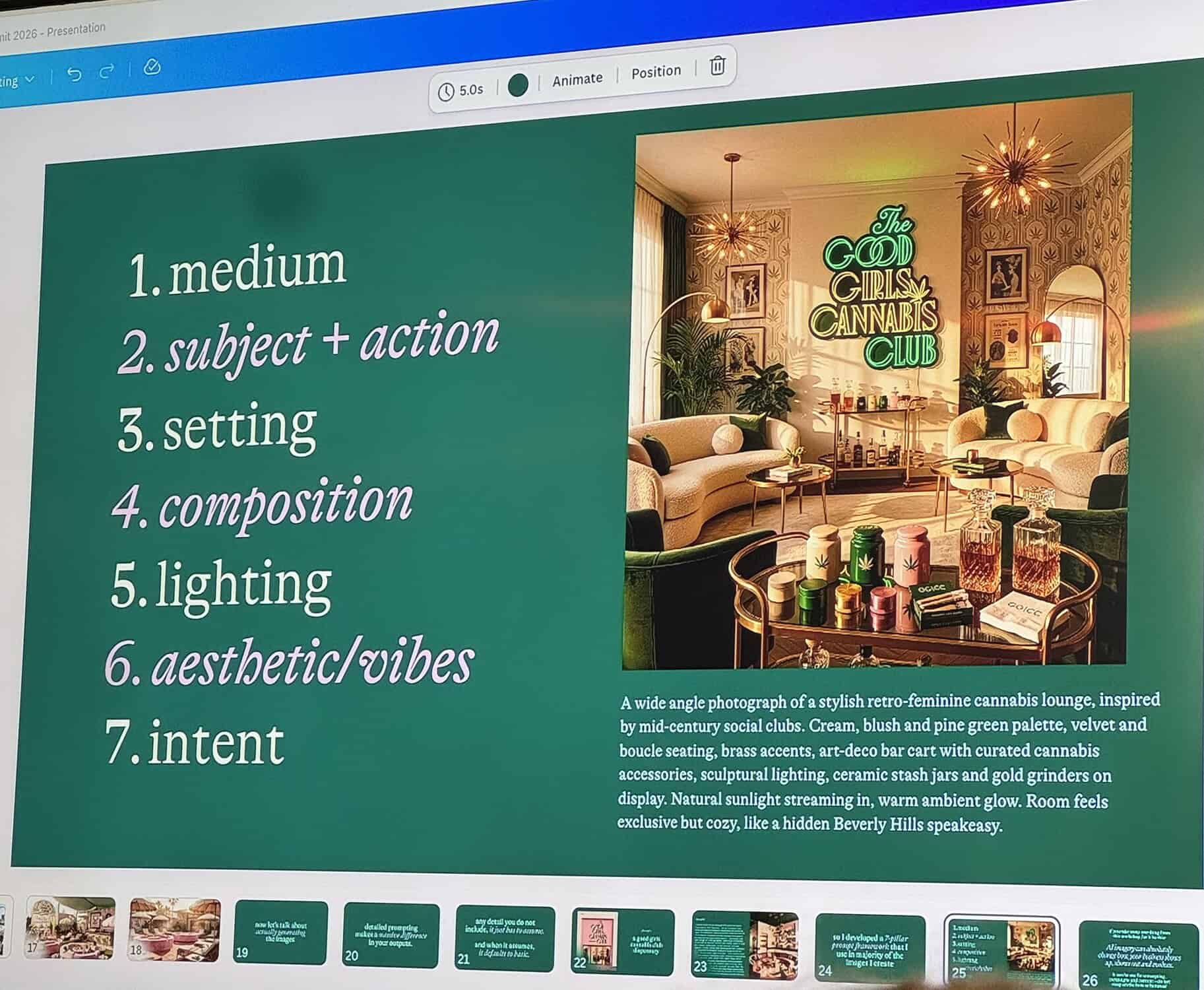
Here’s how to use it.
**First of all, I want to preface this by saying that this works best when you have a project set up (like in Claude), with a bunch of context around your voice, your frameworks, examples of your work and ideologies, a list of approved sources, etc. That way, you’re not starting from scratch every time.
Then, the framework:
1. Format
Tell your AI of choice what it’s making before it starts. A little context goes a long way! Is it creating a blog intro? A LinkedIn post? An H2 with three supporting paragraphs?
Be specific. “Write something about X” is not directions. Imagine if you sent that to a human writer! You’d get an output. Probably not the right one.
2. Topic + angle
The topic is what you’re writing about, and the angle is why your piece is the one worth reading. The angle could come from a counterintuitive take your SME landed on mid-interview, a customer experience that reframes the conversation, or the thing everyone in your industry believes that your data says is wrong.
“Content marketing for wellness brands” is a topic. “Why the wellness brands winning AI search are publishing LESS, not more” is an angle. Every good brief has both, and a prompt that only has the topic will get you a piece that sounds like everyone else’s.
3. Audience
Who is reading this, and what do they already believe? A woman researching hair loss treatments for the first time has different priors than someone who’s already tried three products and is ready to buy.
If you don’t tell the AI whom it’s writing for, it writes for nobody in particular; which is SUCH a specific kind of useless.
4. Structure
How should this be organized? Listicle or narrative? TL;DR at the top or buried? Open with a stat or a scenario? These decisions shape the whole piece. Even better? Give it an approved brief to work with, just like you would a writer.
5. Tone + voice
This is where most prompts fall apart (and where most brand voice guides fail too, but that’s a different issue for a different day). “Professional but approachable” gives the AI nothing to work with.
Pull a paragraph from a piece you love and paste it in. Say “write in this style.” Better yet, use your brand guidelines as a system prompt. Not “be conversational.” Show them what conversational actually sounds like for your brand. The project setup will help, but you should reiterate this for each specific piece.
6. Examples + references
Give the AI something to work with. Give it examples you really like of a framework you’re explaining, or studies and the conclusions you’ve drawn from them as a source to draw from.
AI doesn’t know what “the best version of this” looks like unless you show it, and it won’t tell you it’s guessing.
7. Search intent
What is someone actually trying to accomplish when they find this piece? Are they comparing options? Looking for validation before they buy? Trying to DIY something they’ve never done? Naming the intent changes what the content does, and that difference shows up in every paragraph.
What this looks like in practice
Old prompt: “Write a LinkedIn post about our new IV therapy service.”
New prompt: “Write a LinkedIn post, 150 words max, about why people who feel constantly exhausted keep reaching for quick fixes instead of addressing root causes. The reader is a busy professional in her late 30s who’s tried supplements but never looked into IV therapy. She follows us but has never booked. Tone is conversational and a little provocative, not salesy. Use this post as a style reference: [paste example]. Intent: make her curious enough to click, not sell her on the spot.”
Same topic. Completely different output, and completely different odds of that content doing anything.
Your homework
Pick one piece of content on your list. Before you open any AI tool, write out all seven elements: format, topic + angle, audience, structure, tone + voice, references, intent. It takes maybe 15 minutes. The output will be noticeably different, and so will the time you spend cleaning it up after.
If you want the actual brief template I use, comment, and I’ll send it over!

Karli Jaenike is the Fractional Organic Content, SEO and AI Search Strategist behind Wild Idea, where she helps growth-stage companies turn deep internal expertise into content that search engines rank and AI systems cite. She has 10+ years across editorial strategy, SEO, and content systems, including leading SEO content at Eventbrite and working with enterprise clients at Siege Media. Her framework, Authority Engineering, surfaces the knowledge already inside a company, structures it for both traditional search and AI discoverability, and uses AI-assisted workflows to produce and distribute it at scale. She writes After the Algorithm, a weekly newsletter on AI search and SEO. Based in Texas, she’s a nature lover, live music fan, and travel enthusiast.