TL;DR: A fractional content marketing manager gives you senior content strategy for a fraction of a full-time salary. That part hasn't changed. What changed is the job.
Google and ChatGPT now decide who gets seen based on published evidence of real expertise, and most fractional hires are still optimizing for a search environment that stopped existing.
This page covers what the role does now, what it costs, how it compares to an agency, a full-time hire, and a freelancer, and the questions that separate someone who can do this from someone who says they can.
Your content problem probably isn't the problem you think it is
Most companies hiring a fractional content marketing manager think they're buying output. More posts, a filled calendar, someone to own the thing nobody has time to own.
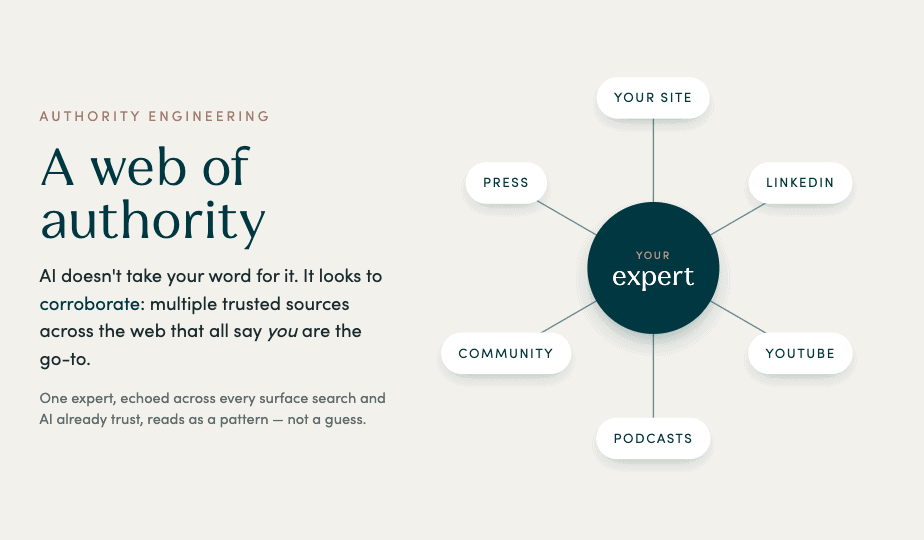
What many people aren’t taking into account is that you're publishing into a search environment that grades on evidence you haven't built yet. Google's AI Overviews and ChatGPT don't reward the company that published the most. They reward the company that has built up authority — with opinions from someone who has demonstrably done the thing, across enough surfaces that a machine can verify it in a fraction of a second.
That being said, there are now tools like AirOps, Profound, and Claude Code that can help make workflows more efficient and help you produce content at scale; hiring a fractional that’s fluent in these tools can be an absolute game-changer.
What does a fractional content marketing manager do?
A fractional content marketing manager owns your content strategy and execution on a part-time, ongoing basis. Especially when that person is fluent in SEO and AI search strategy, you get senior-level thinking several days a month instead of a full-time salary and a full-time seat. The good ones set direction, build the system, and work within the team to stay accountable for results.
A few distinctions people blur constantly, because, well, the roles are similar. But there are nuances:
- Freelancer. Executes defined tasks. You hand them a brief, they write the piece. Great when you already know what you need and just need it created. Many times, this comes with no strategy and little accountability for results.
- Consultant. Completes the analysis, then tells you what to do. Strategy without execution. You're left to build the content engine and ship the content yourself.
- Agency. A team on retainer, usually pod-based, usually optimized for volume. You get capacity. You also get an account manager between you and the people doing the work, and a playbook designed to scale across many clients rather than fit yours. Oftentimes, agencies aren’t great at embedding within the team, and aren’t super flexible to a company's specific needs.
- Fractional CMO. Sits above content. Owns the whole marketing function: demand gen, brand, budget, headcount. If your problem is "our entire marketing org has no leader," you need a fractional CMO (and I have some great ones I can refer you to).
- Fractional content marketing manager, director or head of content. Owns content specifically, sets and runs the strategy, and stays on the hook for the outcome. This can include building out the content operations (typically AI-assisted), hiring a writer’s bench or design team, editing and QA, and prioritizing mass refreshes at scale.
You can find fractional content marketing managers that specialize in different things, I’m sure, but I think it makes the most sense to hire a fractional for SEO and AI search, since those require a seasoned expert to really be effective. (Hint — that’s what we do — strategy and execution oversight, priced for a company that isn't ready to carry a full-time senior salary.)
As you may have noticed with the description above, the scope for a fractional can flex by seniority level:
→ Director-level engagements handle positioning and voice, the content-to-pipeline connection, multi-channel strategy (especially important for AI search strategy), measurement frameworks, and often managing your existing writers or freelancers. This person will work cross-functionally with teams to execute things like off-site mentions, social distribution, etc. — and if you can’t execute in-house, they can hire and manage the external partners that can.
→ Manager-level engagements run the content machine: editorial calendar, briefs, SME extraction, publishing, optimization, reporting. This is the person who makes sure the right things ship and perform.
Plenty of engagements blend both, and in the world of AI search, most do. You want someone who can set the strategy and work cross-channel, but isn't too senior to open the doc and edit a piece.
Why the AI era changes what you need from this hire
This is where many fractional hires can fall short, since not a ton of people are versed in both SEO and AI search strategy.
The mechanics of getting found have shifted, but SEO is still a major part of the game. Google's May 2026 optimization guidance confirms it: its AI features retrieve from the same search index, and commodity content loses while unique expert and firsthand takes win.
ChatGPT works the same way from the other direction. Ahrefs studied 1.4 million ChatGPT prompts in April 2026 and found that cited pages overwhelmingly come from the search index, roughly 88% pulled in through a search reference. You have to rank somewhere to even enter the pool a model chooses from. And the pool is enormous now: ChatGPT alone is fielding hundreds of millions of weekly users treating it like a discovery engine.
So there’s a two-track reality: SEO still moves the majority of organic traffic, around 48.5% of global internet traffic. AEO (getting cited in AI answers) runs on the same foundation but optimizes for a different output.
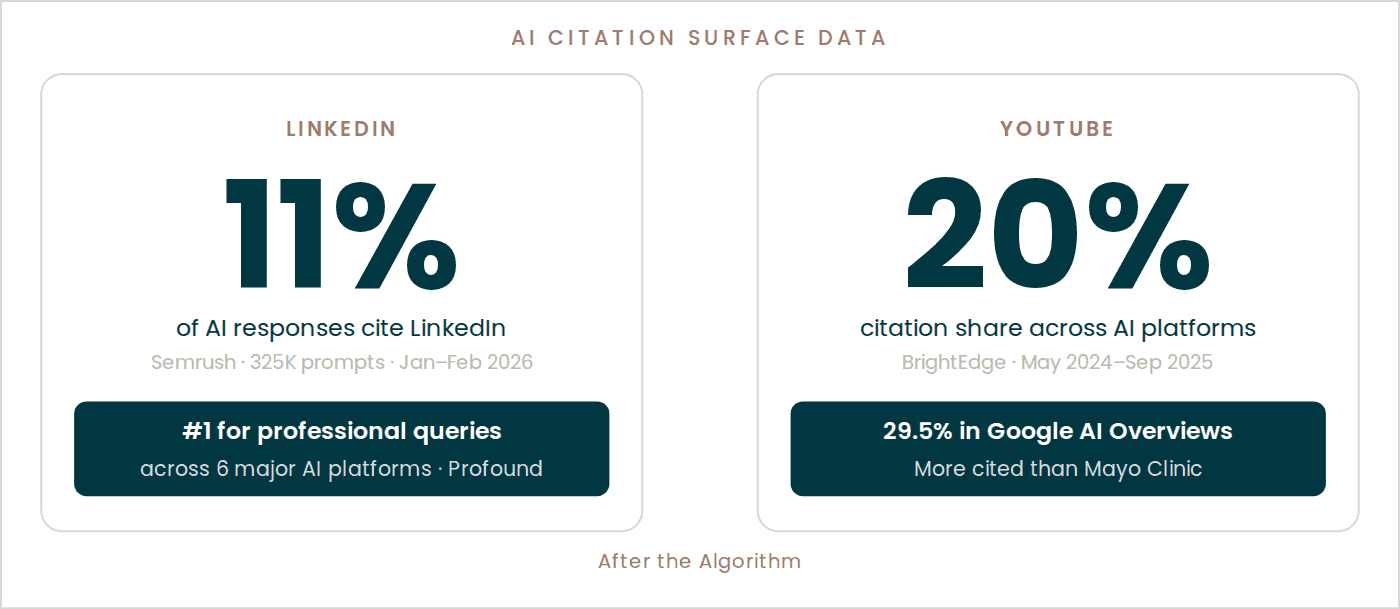
That being said, off-site and cross-channel distribution are incredibly important for AI search. You’ll want a fractional who understands the big picture here.
AI-assisted workflows
Here’s another thing worth considering (and something I’m seeing a TON of demand for right now). The rise of tools like AirOps, Profound, and Claude Code can help streamline content efficiency, and hiring someone fluent in these tools means a lot more can get done with a lot less.
These tools compress the busywork: research, briefing, drafting scaffolds, refreshes at scale, citation tracking across ChatGPT and Perplexity. The hours that used to disappear into production go back into strategy and expert extraction.
And while I’m still a huge proponent for humans in the loop EARLY and often, they mean a fractional (or a fractional with a small writers bench) can output as much as a full-time hire used to.
So fluency with these tools isn't a nice-to-have on a fractional's resume anymore. It's the thing that lets one person operate at the scope of a department without the department's cost.
The layer you shouldn’t ignore, especially in YMYL
Here's the gap I see in so many brands I audit. They have a wealth of internal expertise, and it's sitting undiscovered. The founder, the clinician, the researcher, the financial expert, the person who actually knows the category inside and out. And there is almost no machine-readable evidence connecting that expertise to the brand and content.
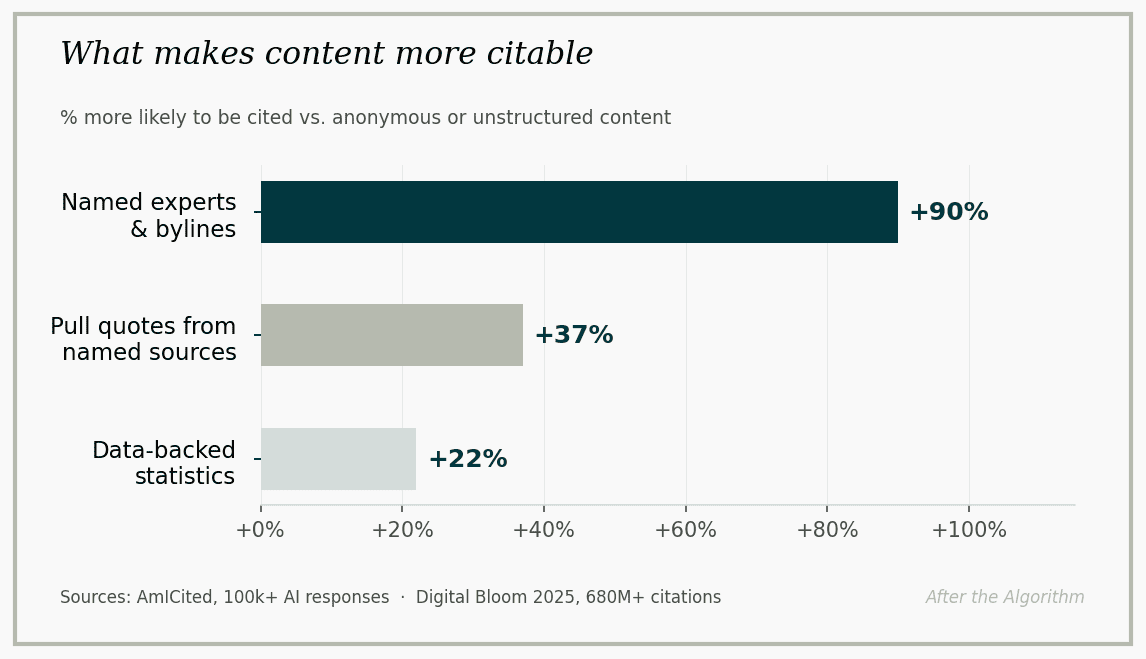
I call it the Credibility Gap. You have the expertise, but AI has no evidence of it. Named authors with a verifiable track record survive the citation filter inside ChatGPT, Perplexity, and Google's AI features. A "staff" or "admin" byline gives a model nothing to check, so the trust signal collapses and the citation odds drop with it. This is a ranking problem as much as an AI problem, because author attribution has been an E-E-A-T signal for years.
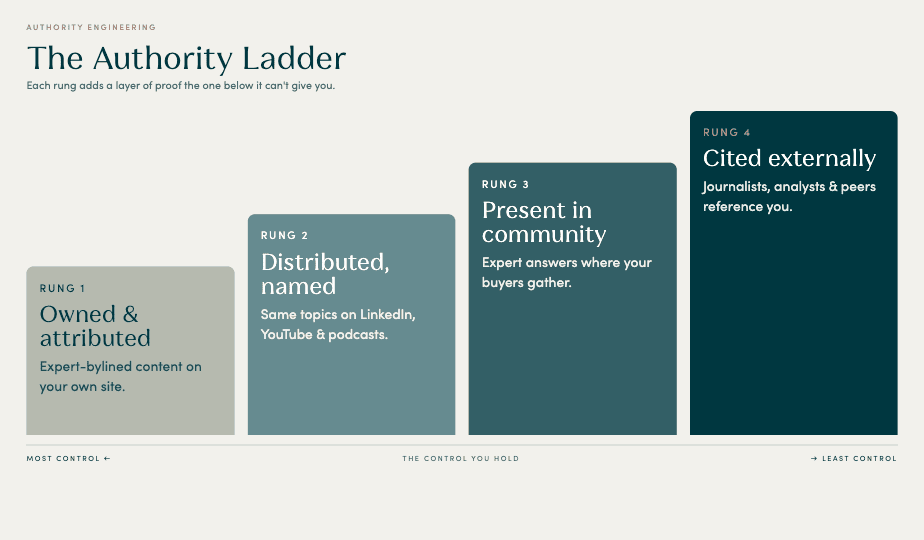
Closing that gap is what I call Authority Engineering. Extract the expertise from the people who have it, structure it for search and AI, then distribute it across every surface a model already trusts. The goal is a body of evidence, not one well-optimized page. A byline that shows up across a trusted article, a named LinkedIn profile, and an earned mention reads to a model as a genuine authority. The same byline on a single anonymous page reads as nothing.
What that looks like in practice: I worked with Restore Hyper Wellness to surface their SME's expertise, structure it for both search and AI, and distribute it across channels. Blog traffic grew 154%, and we earned 644 AI citations in 90 days, not from publishing a huge volume of content, but from publishing evidence a machine could verify and cite.
This matters most in health/wellness, fintech/finance, femtech, healthtech, EdTech, and vettech, where the expertise is structural to whether anyone should trust you, and where compliance layers often keep the experts silent. Your competitor who lets their expert publish is building citable evidence while yours stays locked in a legal review queue.
How much does a fractional content marketing manager cost?
Straight numbers, because this is the question everyone actually wants answered and most pages dodge it. But, as you might imagine, the costs can vary greatly depending on the scope of the project, how much content you want created, and how involved you want the execution to be.
- Manager-level: roughly $3,500 to $8,000/month, depending on scope and hours.
- Director-level: roughly $5,000 to $15,000/month for senior strategy plus oversight of a team or freelancer bench.
Compare that to a full-time senior content hire. Base salary lands around $140,000 to $180,000+, and base isn't the real number. Add benefits, payroll taxes, tools, and ramp time, and loaded cost runs closer to $175,000 to $250,000 a year before they've shipped anything that performs. Then factor the months it takes to hire, onboard, and find someone productive.
Fractional makes this way easier. You get senior strategy in week one, at $42,000 to $180,000 annualized depending on scope and involvement, and you scale the engagement up or down as the work demands. You're paying for judgment and a system, not for a seat and a salary. Plus, you get someone who is *actually* specialized, for only as much time as you actually need them.
An honest caveat: fractional stops making sense once you need someone in the building full time, in every standup, managing a multi-channel headcount. When you hit that, you’ll probably want to hire full-time. A good fractional partner will tell you when you've hit it, and the best ones will help you write the job description and hire their own replacement.

Fractional content manager vs. agency vs. full-time vs. freelancer
| Fractional | Full-Time Hire | Agency | Freelancer | |
|---|---|---|---|---|
| Cost | $3,500–15,000/mo | $175K–250K/yr after taxes + benefits | $8,000–20,000+/mo | $50–150+/hr, per project |
| Strategic level | Senior, specialized, and is flexible to your exact needs | Senior, but one seat | Varies; often junior execution under a senior name | Executes the strategy |
| Speed to value | Week one | 2–4 months to hire and ramp | About a month, after onboarding a pod | Fast, for defined tasks |
| AI-assisted workflow fluency | High; runs a modern stack built for scale and quality | Can have these skills, but often they have to learn the tool | Locked to their stack, built for their margins and quality standards | Varies; usually manual, per task |
| Integration with your team | High; works inside your org | Highest; IS your org | Low; account manager in between | Low; task-based |
| Scales up / down | Yes, by design | No, fixed cost | Somewhat, with retainer changes | Yes, per project |
Fractional content manager vs. agency: a deeper look
I see most companies deciding between a fractional or an agency, so I think it’s worth diving into the differences you’ll likely see here.
An agency sells you capacity. That's the product. Their model works by running a repeatable playbook across a roster of clients, which is efficient for them and fine for you if there isn’t a ton of integration needed with the team.
But here’s one thing to remember: there's usually an account manager sitting between you and the more junior people actually executing. The playbook that makes them efficient is the same playbook that often makes them generic, because it has to work across a dozen accounts. And the incentive structure rewards volume and retention, not your specific outcome.
A fractional content manager sells you judgment inside your business. They sit in your Slack, learn your category, talk to your experts directly, and own an outcome end-to-end.
The person setting strategy is the person building and executing the system, and working to iterate as needed. That integration is important, and it's exactly what an agency's model can't replicate, because their margin depends on not being too embedded in any one client.
Where this matters most: the SME extraction problem. Getting real expertise out of a busy SME and onto the page takes trust, repeated access, and someone who understands the category well enough to ask the right questions. An agency pod cycling through fifteen accounts almost never gets that access, so they fall back on generic content that reads like every competitor's.
A fractional partner embedded in your business does. In an environment where machine-verifiable expertise is the thing that gets cited, that access is the entire game.
None of this means agencies are bad. It means they're built for volume, and if what you need is a system that surfaces your specific expertise and gets it seen, volume isn't the constraint you're solving for.

Who benefits the most from a fractional hire
Fractional isn't right for everyone. It's a strong fit when:
- You're in a high-trust industry with internal expertise that’s structural but stuck in someone's head.
- You're post-seed or Series A/B, with budget for senior strategy but not for a full-time senior salary plus a team under them.
- Your content isn’t performing the way you’d like it to be, which usually means the strategy layer is missing. You need someone additional to come in and solve this for you.
- You're between hires, or bridging a gap, and need someone senior to hold the strategy so momentum doesn't stall.
What to look for when vetting a fractional content hire
The title is unregulated, so plenty of people who mean "freelance writer" or "generalist marketer" use it. Ask these questions, and listen for specifics:
- "How do you approach AI search and getting cited, separately from ranking?" If they treat AEO and SEO as the same exact thing, or can't articulate the difference, they're running the old playbook.
- "Walk me through a result and what actually drove it." Specific numbers, specific mechanisms. Anyone can claim a traffic bump. Fewer can explain why it happened.
- "What does your first 30 to 60 days look like?" You want to hear audit, discovery, and strategy before production. If they're ready to publish in week one without learning your business, they're running a template.
- "How do you get knowledge out of our internal experts and onto the page?" This separates someone who can build real authority from someone who'll churn out surface-level content. If they don't have a process for extracting customer questions or working with your SMEs, they'll produce the same generic stuff everyone else has.
- "How do you measure success, and how does that ladder up to pipeline?" You want someone who connects content to revenue, not just traffic and impressions. Rankings and sessions are the start of the answer, not the whole thing.
- "How will your work leave us better off if we part ways in a year?" Good fractionals build systems your team can use for years to come.
A few red flags to watch out for:
- Promises a volume number as the goal ("30 posts a month"). Volume is an output, not an outcome.
- Can't explain AEO and SEO and doesn’t have a holistic strategy to execute on them.
- Has no point of view on E-E-A-T, product-led topic choices, refresh strategy, etc. This tells you they are just thinking about generic content, not the entire strategy.
- Talks in guarantees. Nobody credible guarantees rankings or citations. Would you ask a lawyer if they can guarantee an acquittal?
- Won't show their own work or name a real result. Obviously this is a problem.

What working with Wild Idea looks like
Our engagements typically run in four phases, of course depending on the specific needs of the company I’m working with.
1. Audit and strategy. I map where you actually stand: rankings, link profile, keyword and citation opportunities, competitor analysis, and the specific places your expertise is invisible to search and AI.
This is also a credibility gap assessment: looking at which internal experts have public attribution and whose knowledge is currently invisible. I do customer research to figure out what product-led topics you should own, and how your current SME’s can support the content we build around it. I figure out where we need to be showing up offsite, too. You leave with a document that names the problems in plain language, in priority order, and a sequenced content plan ready to execute.
2. Build the system. This is where I build the system and the content operations to execute on the strategy. Depending on the need, this could look like an end-to-end content workflow that turns internal knowledge into published, attributed content. Many times, this includes AI-assisted workflows (AirOps, Profound, Claude) and SME extraction frameworks, briefing templates, editorial standards, compliance and accuracy gates, and hiring writers if needed.
There's always a human in the loop. The point is to use AI for the parts that are repetitive and time-sucking, and keep the experts' time on the parts that need a discerning eye. If desired, then we work with the team to distribute across the owned, earned, and community surfaces AI already trusts.
3. Measure and adjust. Track rankings, traffic, and citation presence, sampling what AI systems actually say about you and your category, and tie it back to leads and conversions, not vanity metrics. Then we adjust for what’s working.
Why Wild Idea
- Documented proof. Restore Hyper Wellness: 154% organic growth and 644 AI citations in 90 days. In-house experience at Eventbrite: 164% YoY seasonal traffic growth, 75% content cost reduction, 69% conversion improvement. Real estate brokerage: 5,500 to 70,000 clicks over 18 months.
- SEO and AI search expertise. Highly specialized in these two areas, but with the heart and quality expectations of a content marketer. Wild Idea understands that organic content needs visibility, but it also needs to convert — most importantly, it should be something that your audience actually wants to consume.
- AI-assisted workflows, humans in the loop. We can build a modern stack (AirOps, Profound, Claude Code) that handles the repeatable parts, so we can output at the scope of a team, without the generic result that comes from an agency hire
- Built for high-trust categories. Health/wellness, fintech, femtech, healthtech, EdTech, vettech, the places where expertise is structural and compliance layers keep experts quiet. I understand the SME-access and review problems before you describe them.
- Systems, not dependency. The goal is a content engine you can own for years to come and a plan for hiring in-house when you outgrow me.
Let's find out if we're a fit
If your content isn’t performing the way you like, or you’re just starting out building, tell me where you're stuck, and I'll tell you straight whether fractional is the right move or whether you need something else.
Let's talk ↗, or check out the case studies first.
FAQ
What is a fractional content marketing manager?
A senior content strategist and operator who owns your content on a part-time, ongoing basis. You get the strategic thinking of a full-time hire for a fraction of the salary and none of the ramp.
How is this different from an agency?
An agency sells capacity through a repeatable playbook run across many clients, usually with an account manager between you and a more junior team. A fractional manager sells judgment embedded inside your business, works directly with your experts, and owns a specific outcome.
How many hours a week is a fractional engagement?
It varies by scope. An ongoing partner engagement usually runs around 10 to 20 hours a week, and can be structured around outcomes vs. hours spent. The point is senior ownership and real outcomes, not necessarily seat time.
How long do engagements usually run?
Content compounds, so most engagements run at least a few months to show real movement, and many continue as an ongoing partnership. Some are deliberately time-boxed to bridge a gap or stand up a system before an in-house hire.
Can you work with our existing writers or freelancers?
Yes, and often that’s the ideal setup. I set the strategy, build the briefs and the SME process, and direct your existing bench so their output finally connects to a plan.
Do you use AI to produce content?
Yes, deliberately, with a human in the loop early and often. AI-assisted workflows can handle the repeatable parts of production (research, briefing, refreshes at scale) so the experts’ time goes to the parts that actually need judgment. The tooling lets a lean team output at scale without the generic result.
How long until I see results?
Foundational fixes can move things in weeks. Authority compounds, so the bigger gains land over a few months as the evidence base builds. Anyone promising instant citations or traffic should be questioned.

Karli Jaenike is the Fractional Organic Content, SEO and AI Search Strategist behind Wild Idea, where she helps growth-stage companies turn deep internal expertise into content that search engines rank and AI systems cite. She has 10+ years across editorial strategy, SEO, and content systems, including leading SEO content at Eventbrite and working with enterprise clients at Siege Media. Her framework, Authority Engineering, surfaces the knowledge already inside a company, structures it for both traditional search and AI discoverability, and uses AI-assisted workflows to produce and distribute it at scale. She writes After the Algorithm, a weekly newsletter on AI search and SEO. Based in Texas, she’s a nature lover, live music fan, and travel enthusiast.